Is Prism really an evolutionary step?
Category: Thoughts
-
What does your city say?
Paul Graham’s latest essay “Cities and ambitions” touches upon the topic of the way a city can influence a person’s ambition. The post is US-centric, but there are quite a few interesting points in it.
No matter how determined you are, it’s hard not to be influenced by the people around you. It’s not so much that you do whatever a city expects of you, but that you get discouraged when no one around you cares about the same things you do.
….
Does anyone who wants to do great work have to live in a great city? No; all great cities inspire some sort of ambition, but they aren’t the only places that do. For some kinds of work, all you need is a handful of talented colleagues.
What cities provide is an audience, and a funnel for peers. These aren’t so critical in something like math or physics, where no audience matters except your peers, and judging ability is sufficiently straightforward that hiring and admissions committees can do it reliably.….
Some people know at 16 what sort of work they’re going to do, but in most ambitious kids, ambition seems precede anything specific to be ambitious about. They know they want to do something great. They just haven’t decided yet whether they’re going to be a rock star or a brain surgeon. There’s nothing wrong with that. But it means if you have this most common type of ambition, you’ll probably have to figure out where to live by trial and error. You’ll probably have to find the city where you feel at home to know what sort of ambition you have.
I was not able to entirely appreciate the points made regarding the various cities, having never visited any of them. However, I can draw some parallels with the Indian cities in which I have lived, mostly from a personal point of view rather than a professional one. I was born in Bangalore and spent the first 12 years of my life there. This was of course before the IT related growth, and the Bangalore of today is a lot more crowded and busy.
My next 10 years were in Chennai, one of the 4 Indian metropolitan cities. Chennai is a relatively serious and conservative city (my friends used to complain every time rock concerts bypassed Chennai and went to Bangalore). My last 3 years have been in Kolkata, my native place and another metro, and the lifestyle is quite relaxed. The weather of a city seems to have a considerable impact on the attitudes of its citizens (something my mother mentions quite often).
So, what quirks have you noticed about your city?
-
Lies, leaky abstractions and children
I recently read the essay “Lies we tell children” by Paul Graham, in which he analyses the way in which adults create an abstracted and somewhat idealised world for children.
I’m using the word “lie” in a very general sense: not just overt falsehoods, but also all the more subtle ways we mislead kids. Though “lie” has negative connotations, I don’t mean to suggest we should never do this—just that we should pay attention when we do.
It is a lengthy, but thought provoking essay, and explores the different reasons for which real information is withheld from children. Reasons could range from just maintaining control to the difficulty of putting information in context.
Due to this, the world in a child’s mind takes a binary form consisting of absolutes – right and wrong, good and evil, black and white. This theme can also be seen quite clearly in movies for children (think of any of the Disney animations). However, during the transition from childhood to adulthood, this binary abstraction of the world begins to leak just like any computer related abstraction. Children begin to see the different shades between black and white, and general inconsistencies in the explanations given to them by adults. Some theories seem utterly illogical while others begin to make more sense. The real world also begins to test many of the ideals taught to them.
In this way, the journey to adulthood is somewhat like the transformation of a black and white world with two shades into a full colour world. Some misconceptions persist into adulthood, with inquisitiveness being the best tool to combat them.
Paul Graham’s conclusion from the same essay:
We arrive at adulthood with a kind of truth debt. We were told a lot of lies to get us (and our parents) through our childhood. Some may have been necessary. Some probably weren’t. But we all arrive at adulthood with heads full of lies.
There’s never a point where the adults sit you down and explain all the lies they told you. They’ve forgotten most of them. So if you’re going to clear these lies out of your head, you’re going to have to do it yourself.
Few do. Most people go through life with bits of packing material adhering to their minds and never know it. You probably never can completely undo the effects of lies you were told as a kid, but it’s worth trying. I’ve found that whenever I’ve been able to undo a lie I was told, a lot of other things fell into place.
Fortunately, once you arrive at adulthood you get a valuable new resource you can use to figure out what lies you were told. You’re now one of the liars. You get to watch behind the scenes as adults spin the world for the next generation of kids.
The first step in clearing your head is to realize how far you are from a neutral observer.So how many misconceptions have you been able to shake off?
-
To diigo or not to diigo – a del.icio.us dilemma
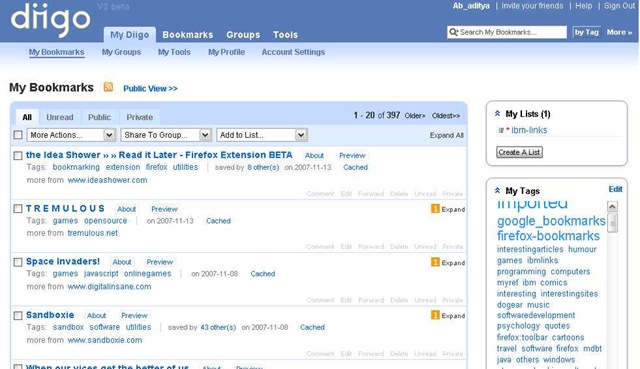
I had posted on my online bookmarking dilemma a couple of months back, and had decided to try out two services – diigo and del.icio.us – based on a basic evaluation of different bookmarking services. I tried out both services for about a month and a half in parallel, by using the diigo extension for Firefox to post simultaneously to diigo and del.icio.us. Last month I switched over to the del.icio.us extension for Firefox to post solely to del.icio.us, and I have continued with this primarily due to its better Firefox extension.
Following is a run down of my observations during the trial run with the two services:
Firefox extensions
I found the del.icio.us extension more handy to use with its suggested tags (your own plus from other users when available) for the bookmarks. The diigo extension on the other hand only had tag auto-completion from the list of tags already used, with no suggestions from tags used by others (it did show other users’ comments when available). Also, the del.icio.us extension provides a button to bookmark the page (something built into the browser Flock by the way) while diigo requires you to either use its toolbar which results in loss of screen real estate (similar to the StumbleUpon toolbar) or right click on the page and choose the bookmark option from the menu (also provided by the del.icio.us extension).
In addition to the ease of bookmarking, the del.icio.us extension also provides a sidebar to search through your bookmarks without having to visit the site.
Website experience
Currently, the diigo site is easily better than the del.icio.us site which has not undergone much of a change in recent times. diigo provides a much better interface. Also, the del.icio.us site is quite slow.
That said, this is due to change soon with both services running private betas for their new sites. Unfortunately I haven’t gotten an invite to either site though I put myself on the waiting list almost 3 months back. However, from what I’ve seen online, the new del.icio.us site looks similar to what is currently available on diigo. See if you have better luck getting into the beta sites:
del.icio.us beta (TechCrunch coverage including screenshots)
Truth be told, I have not had to visit the website of either service much other than to bulk organize some bookmarks and make some setting changes.
Special features
diigo has a much larger feature set than del.icio.us, like text highlighting, posting to other bookmarking sites (something I used throughout to keep in sync with del.icio.us), page caching (this seems to the USP for some users if you look at the TechCrunch post comments on the del.icio.us preview) etc. However, on last try, some features like posting bookmark list to a blog (I discovered that diigo was running on Rails due to the error pages I saw when trying to access this feature), seemed to be buggy. I gave up on the post to blog feature on diigo and switched to del.icio.us which seems to work quite well (though the site leaves much to be desired – the password is in plain text).
Final thoughts (at least till the previews are released)
del.icio.us seems to be serving my online bookmarking requirements quite well (too well if you look at my daily bookmark posts) for the time being. diigo has its uses especially if you are collecting bookmarks for some kind of research – the highlighting can be very useful for annotations (you can also see others’ highlighting if present) and the page cache (available but done manually) should ensure that the page is still available in some form even if the source goes down.
I’ll probably give both services another parallel trial run once the previews are released. And the fact that the import/export feature on both services is quite good, switching back and forth between them shouldn’t be much of a pain (though repeatedly typing “del.icio.us” like I did in this post is).
-
Online bookmarking dilemma
I have been facing the problem of which online bookmarking service to use for quite some time now. This is due to the fact that I have the StumbleUpon and Google toolbars installed on Firefox, and also have accounts on deli.cio.us, blinklist and digg (and possibly some others which I can’t remember right now :-). Too diversified for my own good you say. Well my thoughts exactly. So, if you have any suggestions or comments be my guest.
So let me do some old fashioned analysis on this subject. First off lets list my requirements:
- Convenient to use from browser (few steps to bookmark page)
- browser extensions/bookmarklets to bookmark and tag pages – Brw Extn
- tags suggestions or better yet auto tagging for known pages (a la StumbleUpon) – Tag Sugg
- Easy to search through bookmarks and tags – Easy Search
- Sharing of bookmarks – privacy settings per bookmark – Share
- Post to blog/other service on a timed basis (something like daily/weekly bookmark lists) – Timed posting
- Proper public Atom/RSS feed of bookmarks – Pub Feed
- Import/export bookmarks – Imp Exp
Googling for a comparison of these services gives me this Read/WriteWeb article from about a year ago, but it’s missing Google bookmarks. Looking at the list, diigo does seem interesting though. A shot at Mashable turns up an article on a list of 50+ social bookmarking sites – so much for consolidation. However, furl and bluedot do look interesting (and I have heard of them before) – save copies of the page along with the bookmark hmmm…. sounds a bit like Clipmarks. Looks like we have 2 new candidates for the lineup. So here’s the final lineup for the comparison: StumbleUpon, Google bookmarks, deli.cio.us, diigo, furl and bluedot. Now onto the comparison table (based on my experiences with some of the services, the 2 articles I mentioned and information on the sites) – column headings based on requirements list above:
Service Brw Extn Tag Sugg Easy Search Share Timed posting Pub Feed Imp Exp StumbleUpon Y Y N Y N Y N Google bookmarks Y N Y N N N Y deli.cio.us Y Y Y Y Y Y Y diigo Y Y Y Y Y Y Y furl Y N Y Y ? Y Y bluedot Y ? Y Y ? Y Y Looks like we have a tie in the feature comparison between deli.cio.us and diigo. I’ve tried deli.cio.us before, but diigo does seem quite feature rich and promising. In fact diigo seems to support posting bookmarks to rival services. On the other hand, deli.cio.us is quite well known and supported almost everywhere (wordpress.com even provides a widget), and I have found people posting their bookmarks to their blogs on a weekly/daily basis (possibly using technique like this). Then again diigo is a lot easier to type when making a review :D. It was reviewed favourably on cnet.
Jokes aside, let me try out diigo for some time before I make the final (I wonder if there’s any such thing as “final” ) decision. Now only if there was some way in which I could get my shipment of bookmarks from StumbleUpon to diigo somehow.
To round things up, just a few notes on some of the other services:
- StumbleUpon is still quite good, especially for its “channel surfing” ability, but it’s not the best suited to be used as a bookmark manager. Also, the bookmarks feed does not seem to be supported on some sites twitterfeed and tumblr. So, sharing this way is ruled out for the time being (it does work with Google Reader which supports sharing)
- Google bookmarks is also quite easy to use through the Google toolbar, but there’s no way to share the bookmarks or set their privacy. They did add the missing Import/Export feature sometime back, so we could expect the feature set to grow. Also, there is not much integration with other Google services like notebook, browser sync etc, which makes the service seem a bit orphaned right now.
- I’ve tried blinklist, but the problem with that was the browser bookmarklet which didn’t load properly all the time. So, it failed at the basic level itself.
Update (20/9/2007-4:00pm IST): I’ve started using diigo and imported my bookmarks from deli.cio.us, which is a built in feature, and also installed the diigo toolbar on Firefox. The bookmarking and highlighting feature seems to be working properly, with the ability to post simultaneously to deli.cio.us and other such service (as a backup). However, the daily blog posting doesn’t seem to be properly implemented (getting error messages – seems to be done using Ruby on Rails) yet. So I have set up deli.cio.us for this, and the posting seems to be working properly.
Update (21/9/2007-10:25pm IST): Google has added a shared stuff service which allows you to share websites with others. It is not integrated with Google bookmarks at the moment, but the email feature is linked to your gmail account, plus there’s an RSS feed. So, 2 of the missing features in Google bookmarks (sharing and public feeds) could possibly be taken care of by this service.
- Convenient to use from browser (few steps to bookmark page)
-
The Unreasonable Effectiveness of Mathematics in the Natural Sciences
One of my friends pointed me to the article “The Unreasonable Effectiveness of Mathematics in the Natural Sciences” by Richard Hamming after I had sent him the link to Richard Hamming‘s talk “You and you research“. The article itself is quite thought provoking and makes you take a different view at Mathematics, something which we take for granted.
He presents the evolution of Mathematics quite beautifully – how various parts like algebra, number system, geometry came into being, and how they fit into the world as abstractions of what we observe around us. Now only if we could get Maths to effectively abstract the stock market ;-). Maybe Warren Buffet could give us some pointers on that with Buffettology.
On a side note regarding the talk by Richard Hamming, it is also quite thought provoking and makes you think about what you want to do in life, and setting your priorities accordingly.
-
Ideas and boiling liquids
How do you capture and subsequently flesh out thoughts/ideas that come to your mind? After all, they are like boiling liquids, i.e., vaporize unless you manage to capture them. This is one of the problems I have wrestled with quite often. Lots of interesting thoughts come to my mind, especially at odd times (while traveling, before going to sleep etc), of which quite a few should have ended up on the blog.
The problem has been sustaining the thoughts and then giving them a more comprehensible form which can be shared with others. After all, not every thought is going to lead to Archimedes’ Eureka moment, and such means of propagating ideas can be more or less ruled out. It is also too bad that we cannot collect our thoughts directly into a pensieve and experience them later.
So what choices are we left with to condense and collect the ideas before they vaporize entirely leaving no residue behind? Well, there are quite a lot of ways we can put down our thoughts, ranging from recording voice messages on the phone, making notes on some electronic device (phone/PDA/computer) to just going for the simple, cost effective pen and paper method. However, this only gives my thoughts an added degree of permanence, and not the form in which they can be readily shared. They are still too abstract (something like bullet points) to be readily comprehensible to others.
The final mile (putting everything together in a coherent fashion) is probably the hardest, and this is what ultimately determines the fate of the thought – whether it gets published in the blog (or any other equivalent sharing medium) or remains confined to the draft bin. Of course, depending on the kind of thought/idea there may be a tougher journey ahead whereby it gets realized or implemented, but that’s another story altogether.
So, in effect, the thought cycle is quite a lot like oil exploration. A thought which passing through your mind is similar to striking oil, with a lot of initial enthusiasm. Then you need to drill down further to explore (put down your thoughts) or just ignore the occurrence. If you do drill down, you then have to extract and purify so that it can be distributed (as petrol, diesel etc in case of oil).