Quite a lot of smart ones there including Harshad Mehta and Ford. Of course, not all the smart moves were good for the society at large.
Category: Thoughts
-
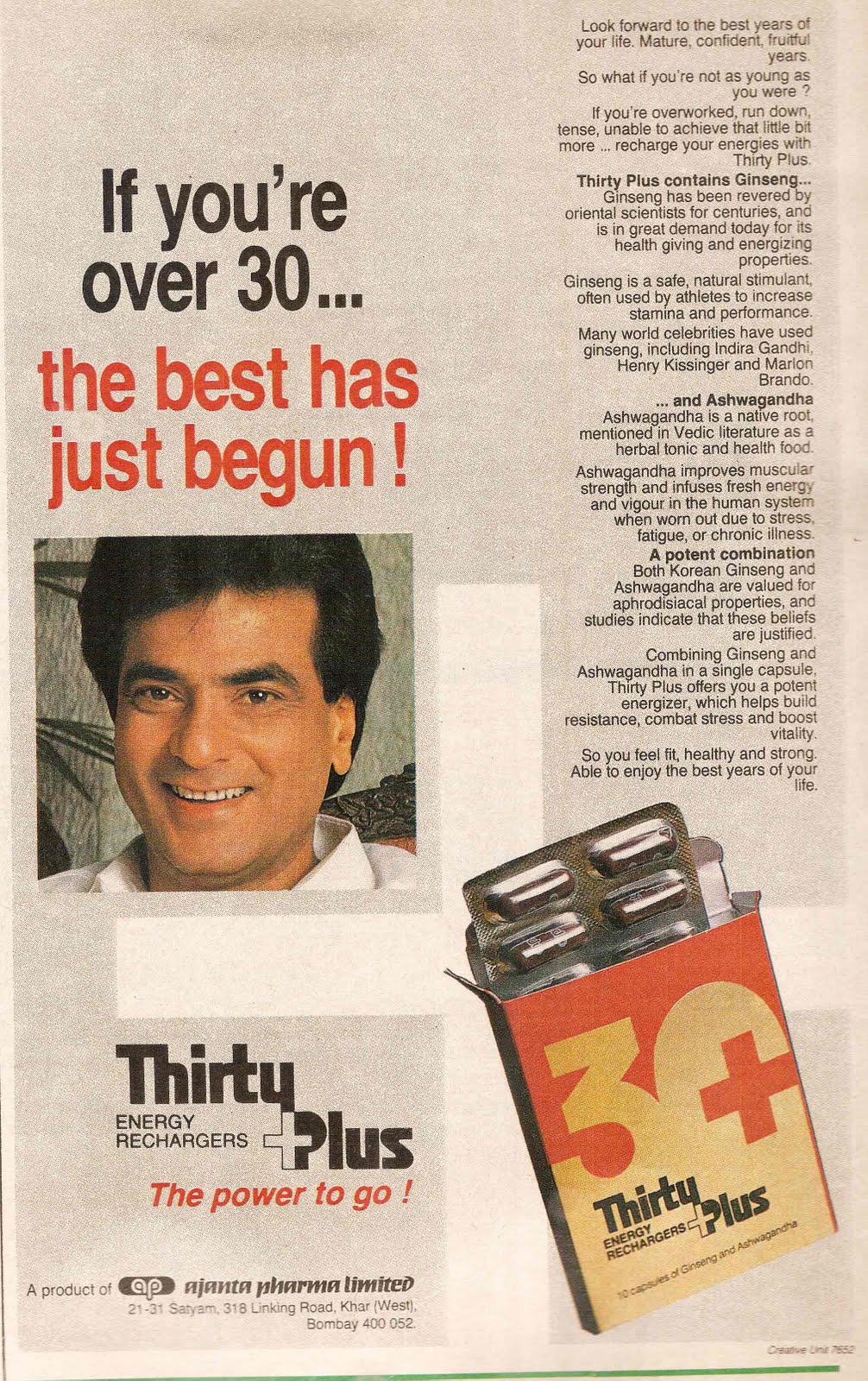
The 3 Decade Club
I crossed 30 last month, and that reminds me of the 30 plus ads featuring Jeetandra. Looks like the brand has been relaunched and positioned quite differently.
-
Water Privatization and the Diamond Monopoly
I came across this article critiquing the Nestle CEO on his views on water privatization:
In a candid interview for the documentary We Feed the World, Nestle Chairman Peter Brabeck makes the astonishing claim that water isn’t a human right. He attacks the idea that nature is good, and says it is a great achievement that humans are now able to resist nature’s dominance. He attacks organic agriculture and says genetic modification is better.
A comment on a wordpress reblog of the article lead me to an article by the CEO himself invoking the “tragedy of the commons” that quotes quite a few examples from India:
On the other hand, however, some at that time might have found the interpretation of a human right to water rather undifferentiated and radical. This rather extreme interpretation considered any withdrawal a human right and water as a free good. This interpretation is much less widespread today, but if accepted by more people, it could potentially have had serious consequences. The people defending this very extensive view were quite vocal, at times even aggressive. Whoever wanted to set a focus and add some more clarity here – and I was among those – was attacked.
That in turn reminded me of an article from 1982 regarding the way the diamond trade evolved to make diamonds a status symbol. The objectives were probably quite different, but notice any similarities with the water privatization solution?
The diamond invention is far more than a monopoly for fixing diamond prices; it is a mechanism for converting tiny crystals of carbon into universally recognized tokens of wealth, power, and romance. To achieve this goal, De Beers had to control demand as well as supply. Both women and men had to be made to perceive diamonds not as marketable precious stones but as an inseparable part of courtship and married life. To stabilize the market, De Beers had to endow these stones with a sentiment that would inhibit the public from ever reselling them. The illusion had to be created that diamonds were forever — “forever” in the sense that they should never be resold.
-
Mr. Smith Never Made it to Washington
I guess the US Senate hasn’t changed all that much in over 70 years:
In Mr. Smith Goes to Washington, however, the decent common man is surrounded by the most venal, petty, and thuggish group of yahoos ever to pass as decent society in a Capra movie. Everyone in the film — except for Jefferson Smith and his tiny cadre of believers — is either in the pay of the political machine run by Edward Arnold’s James Taylor or complicit in Taylor’s corruption through their silence, and they all sit by as innocent people, including children, are brutalized and intimidated, rights are violated, and the government is brought to a halt”.
via Mr. Smith Goes to Washington – Wikipedia, the free encyclopedia.
-
Chashme Baddoor past and present
I was pretty disappointed that I was not as disappointed by the Chashme Baddoor remake as I had anticipated from the promos. In fact, I had planned on skipping the movie altogether, but ended up watching it based on my parents recommendations. Also, the fact that Rajeev Masand gave it a fairly positive review helped (my tastes seem to line up with his on most Hindi movies). Also, just to make get my frame of reference right, I followed up the remake with the evening show of original classic.
So, here are my thoughts as usual:
- The remake works solely due to the performance of the support cast with the lead actor & actress being eye-candy. This was the most jarring departure from the original where Farooq Shaikh & Deepti Naval are at the forefront and their chemistry is the backbone of the movie.
- If the lead cast of the original is a cake with the support cast adding the layers of icing, then the remake is more like a kaju barfi with the hero & heroine serving as the silver foil for decoration without adding to the taste.
- In the remake, Ali Zafar seems to be a Physics student, and that seems to explain the lack of Chemistry with Taapsee Pannu.
- Watching the two movies back to back served as a good reminder of the way the story telling pace has evolved over the last 3 decades. The original has a fairly laid back pace, while the remake tries to maintain a laugh a minute pace.
- The remake has adapted quite a few of the original’s scenes starting with the balcony sighting of the heroine, leading up to the fake kidnapping.
- The money exchanging hands sequence also gives you an idea of the kind of inflation we have had – Rs 10 in the original vs Rs 500 in the new one. As a side note, this is also a basic economics lesson that we see floated on social networks where 3 people manage to settle debts without anyone getting richer.
- I preferred the songs of the original, particularly the classical ones.
- I wonder whether the “Andha Ghoda Race Mein Dauda” from the remake is a take on the “Kali ghodi dwaar khadi”. The timing in the movie is somewhat similar.
- Cigarettes feature a lot more prominently in the original, but there were no warnings during the screening in the theatre unlike the remake. Of course, Saeed Jaffrey as Lallan Miyan makes a pretty good case against smoking to Farooq Shaikh in the original.
- Omi’s shayari is a lot more sophisticated in the original.
- The posters on the wall between the 3 friends had more variety in the original, especially for Omi and Siddharth.
- They retained the names of the 3 friends, but changed it for the female lead in the remake (Seema vs Neha). Wonder whether it was only for the puns & shayaris.
- They managed to force in the Miss Chamko bit in the remake, albeit not with the same impact as the original.
- The remake definitely didn’t emphasize on employment on part of the lead characters unlike the originals where Deepti Naval works as a part time sales person to pay for her music lessons.
Bottom line is that the remake is a typical David Dhawan entertainer where you can give rest to the grey cells, while the original remains a classic and seeing it on the big screen was a unique experience.
-
Who’s Going To Buy The Facebook Phone?
Wonder whether this will prompt Google to give a similar treatment to Android with Google+ and its plethora of services? Or “better” yet, to the next Nexus device. After the Google+ification of search, anything’s possible.
But that’s hardly the entire phone market. It’s actually only a fraction of it.
- What about those millions of people who have bought Android phones — and some iPhones, probably — who don’t really care that they’re Android phones, or even smartphones?
- The types of people who, every couple of years, go into the Verizon or AT&T shop and walk out with whatever newish thing the store rep says they should buy? (All those people who buy Android phones but don’t really show up in usage logs.)
- Or even first-time smartphone buyers?
My guess is that many — most? — of these people are Facebook users, and could easily see some utility in having Facebook features highlighted on their phones. And — bonus — Facebook’s software looks good. Much better than the junk that ships with typical low-end Android devices.
-
Apple Inc.: Founding and incorporation – Wikipedia
There is a reason why Apple has better things to do than create gags on April 1:
Apple was established on April 1, 1976, by Steve Jobs, Steve Wozniak and Ronald Wayne to sell the Apple I personal computer kit.
-
HTC One V: 2 week usage review
Update (17 Aug 2012): My HTC One V died last month (in less than 3 months), and by died I mean totally bricked just sitting in my pocket – wouldn’t turn on or charge. This seems to be a fairly common problem with the initial batches of the phone. I changed my flipkart review due to this. In case you are wondering what the problems are, try searching these terms on Google: “HTC One V dead”, “HTC One V not turning on” & “HTC One V bricked”.
Original review
I finally gave up on the Android dead end (no ICS upgrade) that was my Galaxy S i9003 and decided to jump to the ICS bandwagon. The only options for an out of the box ICS experience in India at this time are the HTC duo – One X & One V. Of these, the One X was beyond my budget, and so it was a pretty simple decision to go for the One V in the end.
Reviews have been pretty positive, and I’m throwing in my 2 cents based on a 2 weeks of usage experience that wouldn’t have shown up in initial reviews. A caveat on my usage experience – I use the One V (and the Galaxy S before it) primarily as a mobile internet device (mails, browsing, e-commerce, social networking etc.) rather than for phone calls.
What did I get over the Galaxy S i9003?
The build quality is definitely impressive with the metal body, and it is also sleeker than the Galaxy S. I personally prefer the One V’s build quality over the Galaxy S.
In terms of software, ICS definitely offers a better experience than Froyo (there is a Gingerbread update for the Galaxy S, but I never got to install that during my 1 year with the phone – Kies didn’t work, so I ended up installing it through Odin). It is also a lot more stable, and I haven’t had any lockups that required hard reboots on the Galaxy S.
The HTC widgets are also pretty handy plus there are the new ICS widgets for Gmail & Email, I’m still using the Sense launcher on the One V. I had replaced the Touchwiz launcher on the Galaxy S with Launcher Pro. The Gmail & Mail clients are also definitely improved over Froyo. In particular, the mail client now has better support for Microsoft Exchange with better threaded views and flag support.
The main camera is also pretty good on the One V, though the resolution is still 5 MP like the Galaxy S. The optics are definitely better (f2.0 lens), and there’s also an LED flash (not that useful though, as it tends to blowout the photo). The bigger improvement is on the software side with the negligible shutter lag, incredible burst mode and the quick launch option from the lock screen (you need to have the camera icon in the tray for this).
GPS performance is another area where there is a big leap with the One V locking on pretty quickly. This is an area where my Galaxy S was severely lacking, and I left GPS off most of the time, unlike the One V where I have it on most of the time.
Battery life on the One V also seems to be better compared to the Galaxy S. It holds out pretty well over the day even with sync and GPS active, even though the battery capacity is lower.
The SoC of the One V is also better than the Galaxy S – the Qualcomm CPU-GPU combo has better performance than the TI CPU-GPU combo in the Galaxy S. GPU performance is particularly better (aided by the ICS improvements).
Also, did I mention that I can use Chrome (ICS only for now) on the One V.
What did I give up?
The most obvious downgrade is in terms of the front camera, as the One V doesn’t have it. However, I rarely used it on the Galaxy S (didn’t work with Skype, possibly due to Froyo lacking native front camera support), so not such a big loss personally. Then again, the front camera does make for a handy substitute of a mirror.
The One V also lacks a digital compass (wonder whether it is due to the metal body), and is not able to show you the direction you are facing on maps unless you are on the move. In addition, apps like Google Sky Maps which relies on the compass to show you the skyline are virtually useless (maybe if I run around in circles with the GPS on, it’ll know the direction I’m facing). This is a more serious omission for me, but I’ll have to learn to live with it.
The screen size is also smaller, and makes for smaller on screen elements for tapping. Not a very big difference, but when it comes to browsing and interaction, a larger screen is always handy.
The battery on the One V is also sealed in, while it could be replaced on the Galaxy S. Then again, I never really had an extra battery, and it was actually a bit of a bother as I had to remove the battery on the Galaxy S to insert the SIM. This makes the One V sleeker, so a net gain for me. Also, battery life on the One V is better than the Galaxy S.
The missing physical menu button on the One V (due to the ICS UI changes) was also a bit of a problem initially with apps like Whatsapp, facebook etc. that have their settings accessible only through the menu button. However, I discovered that a long press of the app switching button simulates the menu button press, and the settings have not been able to hide from me ever since.
What remains on par?
Though the screen size is smaller, the screen resolution is the same (480×800), which makes for a better pixel density. The camera resolution is also the similar, and so is the RAM (around 500 MB) and on board memory (4 GB, but less of it is available to the user on the One V).
Migration pains and misc.
There is still no simple way to migrate from one Android phone to another, especially when they are from different OEMs. For all the talk of everything moving to the cloud, and iTunes remaining a big bloat, the iOS-iTunes combo still remains a good way to backup and restore your apps (I own an iPod & iPad 2 as well). It is a big pain to have to install every downloaded app all over again, and then set them up.
That said, my photos & videos made a seamless transition thanks to them being stored on the external SD card that I moved from the Galaxy S to the One V. However, I can imagine things won’t be as simple for Android phones that lack external storage support. Moving apps to the SD card in hopes of them being restored on the new phone also didn’t play out as expected and I ended up setting up the apps all over again. Android needs to better way to tackle this issue, as the people change phones pretty often and setting it up every time results in a lot of wasted time.
While stability of ICS is definitely improved over Froyo (or at least HTC’s version of ICS is better than Samsung’s version of Froyo), there are still some nagging issues. The Play store still shows the same app updates for some apps at random, even after they have been installed. The data connection just freezes at times, and only a phone reboot seems to fix it (airplane & data mode toggle don’t seem to help). The calendar widget doesn’t refresh properly every day, so I end up seeing the current day mentioned as tomorrow\day after.
The UI can also be a bit sluggish at times, but it is definitely an improvement over the Galaxy S. I suspect Android requires a dual core to perform well, as the Galaxy S II was one of the first Android phones where the reviewers didn’t mention the UI lag.
And last but not the least, it still doesn’t play Fruit Ninja as well as my 3rd gen iPod touch.
Bottom line
The One V is one of the best phones available under Rs 20,000 at the moment. In fact, it is cheaper than the Galaxy S i9003 (it has held up its value well over the last year – still costs around Rs 19,000). Of course, you can get older phones that have ICS upgrades rolling out at similar price points, but the One V has the hardware to hold its own. Barring the digital compass and app setup, it was a satisfactory upgrade to my Galaxy S i9003.
