Tag: India

  • India’s Race Between Demography and AI

    India’s Race Between Demography and AI

    Artificial Intelligence is often framed as a threat to jobs—a disruptive force poised to replace human labour at an unprecedented scale. From call centres to accounting firms, from routine coding to legal research, Generative AI and automation tools are already demonstrating capabilities that once seemed untouchable. The fear of widespread job loss is not unfounded. McKinsey, among others, estimates that nearly a quarter of global work activities could be automated by the early 2030s.

    Yet, there is another equally significant demographic trend reshaping the labour market—the aging of populations. In countries such as Japan, South Korea, Germany, and even China, the working-age population is shrinking. This is not because jobs are disappearing, but because people are. Fertility rates have fallen below replacement levels, and the proportion of elderly citizens is rising sharply. These nations face a paradox: they need more workers but have fewer people available to fill roles.

    AI and Aging: Complementary Forces in Developed Countries

    This is where AI and aging unexpectedly complement each other. In economies that are already greying, AI is less a destroyer of jobs and more a replacement for the labour that no longer exists. Japan, for example, has pioneered the use of robotics and AI-driven systems not to replace young workers, but to stand in for absent ones—care robots for the elderly, AI-assisted diagnostics for hospitals short on doctors, and factory automation for industries facing chronic staff shortages.

    In such societies, the fear of AI taking away jobs is muted by the demographic reality that many jobs would otherwise remain unfilled. AI is effectively stepping into the gap created by demographic decline. For them, the challenge is not managing unemployment but managing the technological transition in a way that sustains productivity and care standards as their populations age.

    India’s Young Advantage—and the Ticking Clock

    India, however, tells a different story. The country’s demographic structure is still overwhelmingly young. Nearly two-thirds of Indians are in the working-age bracket, and the median age is around 28—more than a decade younger than China or the U.S. This “demographic dividend” has been hailed as India’s biggest economic advantage for the next 10–15 years. But this window is finite.

    Demographers estimate that by the mid-2030s, India’s working-age population will peak. After that, the proportion of elderly citizens will start rising sharply. By 2046, the elderly are projected to outnumber children under 14. In other words, India’s advantage will begin to fade just as many advanced economies have already entered the post-dividend phase. If India cannot create enough productive jobs during this critical decade, its youth bulge may turn into a liability.

    AI’s Adoption Curve

    The question is: will AI go mainstream while India’s workforce is still young? Current projections suggest that large-scale AI adoption is still 5–15 years away. Today’s Generative AI tools, while impressive, remain in an experimental phase. They lack reliability, governance frameworks, and cost efficiency at scale. Gartner’s hype cycle places most AI technologies in the “Trough of Disillusionment,” meaning that widespread productivity gains will take years to materialize.

    If this trajectory holds, AI’s mainstream integration across sectors like healthcare, education, law, and public administration may not happen until the 2030s—roughly the same time that India’s demographic dividend starts to decline. This sets up an intriguing scenario where India’s labour market transition and AI’s maturity could synchronize.

    Possible Scenarios for India

    1. The Collision Scenario:

    If AI adoption accelerates too quickly, India’s youthful workforce may find itself competing against machines for jobs before the country has built a strong industrial and service base. Sectors such as BPO, customer service, and low-skill IT roles—once the backbone of India’s outsourcing economy—could see rapid automation. Without massive reskilling efforts, unemployment among young Indians could spike even as the global economy demands fewer entry-level jobs.

    2. The Missed Opportunity Scenario:

    Alternatively, if AI adoption lags too far behind—say, beyond 2040—India could enter its aging phase without having reaped the productivity gains AI promises. By then, the country would face the dual pressures of a shrinking workforce and a delayed technological transition. This would mirror some of the struggles seen in late-industrializing economies that missed the manufacturing wave.

    3. The Synchronization Scenario:

    The most optimistic possibility is that AI and India’s demographic transition align productively. Over the next decade, India could use its young workforce to build, train, and scale AI systems, preparing the ground for when labour shortages begin. By the time the aging curve hits in the 2035–2040 period, AI could step in not as a threat, but as a productivity amplifier—automating routine tasks while humans focus on complex, creative, or empathetic roles.

    This requires a proactive strategy: early investment in AI literacy, creation of AI-enabled jobs (rather than job replacement), and building a global service economy where Indians are not just users of AI, but architects of AI solutions.

    The Decisive Decade

    India’s story in the 2030s will be defined by the intersection of two megatrends: a maturing workforce and a maturing technology. Whether this convergence leads to disruption or opportunity depends on choices made now—in education, infrastructure, governance, and industry adoption. The challenge is to ensure that when AI becomes mainstream, India’s workforce is not left behind but is ready to ride the wave. The 2020s are not just a decade of demographic advantage—they are the runway for an AI-driven, post-dividend future.

  • How to change your airtel corporate mobile plan

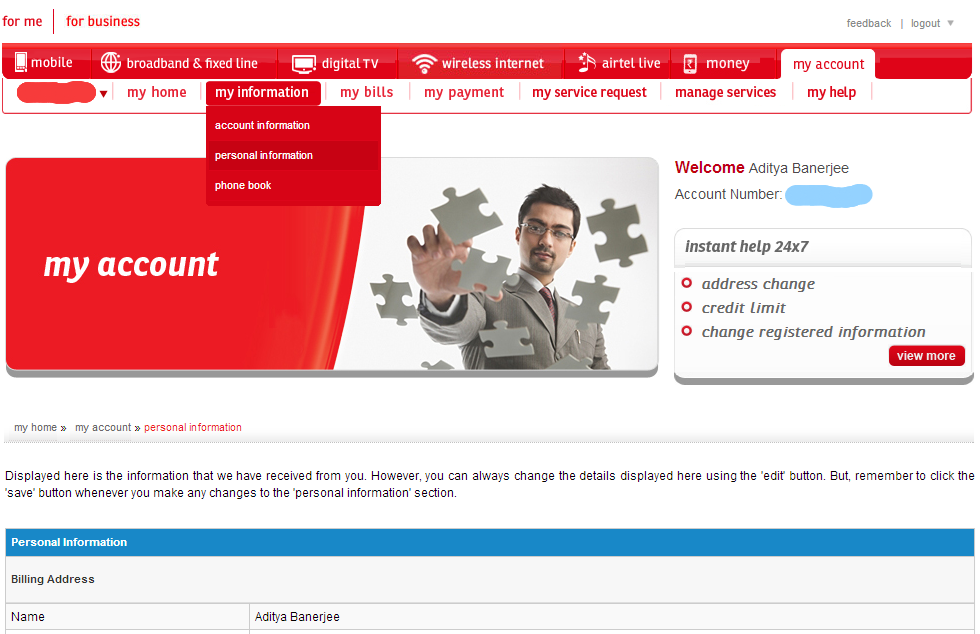
    I have a corporate airtel postpaid mobile connection and the plan was not very cost effective for my usage pattern. However, trying to change the plan by giving a call to their 121 call centre was of no use as the support staff seemed to lack the access to change corporate plans (in fact they didn’t even seem to have proper visibility to my eligible corporate plans). In fact, the phone support told me to visit an airtel relationship centre for a plan change. The website wasn’t of much help either as corporate plans can’t be switched online, and the airtel website is seriously lacking in any kind of details on postpaid corporate plans.

    Email was a different story, and their response time is pretty phenomenal with replies coming in within 4-5 hours even on weekends and nights. And this was the route that ultimately got me success. So here go the steps:

    1. Log on to the airtel account management site (if you know your registered email ID, jump to step 3).
    2. Check your email address under the personal information section and update if not active (you can also sign up for an ebill under the bills section).
    3. Send a mail to 121@in.airtel.com from your registered email address with the name of the plan you want to switch to, and your mobile number as the subject. In case you are not sure of the plans you can switch to, drop them an email first asking for the available plans. Word of advice: keep your message short, simple and to the point.
    4. You should receive a confirmation mail and voila, you’re done!

    If you are curious on the plan I got, it was the Alive Net CUG 375 Combo Plan with 600 minutes of local & STD talktime and 1 GB of 3G data as part of the package. There are similar combo plans available that are tuned for local usage if you are interested, and they are quite economical when compared to your usual subscription of a call plan with a separate data plan.

  • Quora: What are some things that you can do in India but not in the US?

    Some of the other answers are pretty good as well, but this one is probably the most feel good.

    Answer by Balaji Viswanathan:

    1. I can go to a doctor with no insurance, no paperwork, get treated, buy  medicines and come back in an hour with a total expenditure of just  $1-$2. (This is a private practitioner who was educated almost for free by the government. Typically, a GP sees 50-100 patients everyday and makes $200/day.) And some of these doctors are the best in the business. This is  one of the things where India knocks most countries hands down[1]. It is not just cheap, it is also also as uncomplicated as going to a grocery store. In fact, our doctors become good family friends and act as everything from a notary to a life consultant 😉

    2. I can go and buy healthy stuff cheaper than unhealthy stuff. A kilo of  fresh mango costs about Rs. 20 ($0.35) during season while a 1 liter bottle of Coke  costs Rs. 40 ($0.70). Same with idli vs. pizza or roti vs. Big Mac. In India, you  have to pay big bucks to eat unhealthy. In the US, it is the other way  around.

    3. Weddings, festivals and family events. India again wins hands down. Try spending Holi in Delhi, Ganpathy Pooja in Bombay, Durga pooja in Calcutta and Pongal near Madurai and you will see what is incredible about India. In US, except for July 4 and to some extent Christmas, most festivals are low key. I’m surprised that most people don’t even come out to the streets to celebrate Christmas or New Year in most US cities.

    4. Drop in randomly to relatives/friends homes. Although in some Indian metros, people are acting “Western” and requiring appointments to go to their home, in most normal Indian homes you can drop in without an appointment. My wife and I always go to our inlaws place without notice to surprise them. This element of chance & surprise adds to further excitement. In the US, I find things too formal.

    5. Get stuff repaired instead of throwing to landfill. Indians are very efficient in repairing/reusing stuff. In the US, people throw out their gadgets and appliances as soon as they reach the first failure. In India, you can go to a mechanic/electrician and get stuff repaired. The amount of waste generated per person is extremely low.

    6. Low cost education. We can spend weeks on finding what is at fault with our education system, but the fact of the matter is that we are very efficient at what we are doing. Most of us went to private schools where it costs less than $500/year (although, this is changing as more parents want trophy schools now). Our colleges are only a little more expensive than that. This is despite the government spending almost nothing on our education. Most students in the US are overburdened with debt just after their college. It is not just cheap, it is also safe. Whether it is rapes, murders or shootings, our colleges do far better in managing crimes than do US campuses. Even during major riots, you will never see a major campus of IIT/IIM/NIT affected in any way.

    7. Public Transportation. In almost all Indian cities there is viable public transportation. If there is no bus or train, there will always be a ubiquitous autorickshaw costing about $0.2/km. In the US, I had terrible problems going from one city to an another before I bought my car.

    8. Affordable entertainment and communication. In India, almost anybody (even a slumdweller) can afford cable TV. A full service cost about $2-$8/month. Same for mobile phones where incoming calls are mostly free and one can have an usuable phone plan for about $5/month. However, in the US even many upper middle class families have to think twice before going for full cable service.

    9. Walkable cities and towns. India has not yet moved to a US style suburbian sprawl. That means in most towns & cities we can walk/bike to most essential amenities – grocery shops (h/t Niranjan Uma Shankar), medical clinics, restaurants.

    10. Political system. We sure have got plenty of troubles in our democratic setup, but ours is the only democratic setup where a minority can rise up to the top with no background. When Abdul Kalam became the third Muslim President in 32 years, India’s right wingers didn’t howl. This is in sharp contrast to how US right wingers reacted to Obama’s little bit of black lineage. The President was born to a white mother, raised in white neighborhoods, went to Ivy leagues, but still was trashed by the right wing. President Kalam had no political background, no strong network and no money, just lots of brains to get him up there. Although our population is 85% Hindu, we have had Sikh Prime Ministers and Presidents, Muslim Presidents, Zorastrian business leaders… Can a Hindu/Muslim immigrant realistically become a premier in Italy or Germany or Australia? We are not perfectly secular, but this is one aspect where we beat every other nation in the world.

    11. Finally, good food. I live in a nation where a Samosa costs Rs 4 ($ 0.08). In Mumbai, we used to have a great dinner at roadside shops for $1 (for 2 of us). Whether it is Idly, Papdi chat or Samosa, it is a luxury in the US. I miss the chats of Delhi & Mumbai, Saravana Bhavan of Chennai and Rosgollas of Calcutta.

    —————-

    [1] Our medical system is so direct & simple, if you are not dirt poor. One of my close friends had a mild bout of fever as soon as he came to the  US. In India, this is a pretty simple thing. Here, the doctors made him take so many stupid tests that the bill finally ran to $800. Good that his insurance coverage started the previous day. Still, he had to run around filling up papers for a whole week.

    —————–
    Endnote: I  can also name 11 or more things where you can do in the US but not in  India. So, it is not about jingoism or one nation better than the other.  It is just a discussion about relative merits of one nation vs. the  other. Every nation is great in its own way, and there are some stuff that one nation beats the other, while in other stuff gets beaten.

  • Social Networks for Rural India

    A few weeks back, I participated in the net.works case study competition of IIMA’s Confluence along with 3 of my classmates in SJMSOM, IIT Bombay. As a part of the competition, we were asked to prepare a report on what a social network with 500 million users in India would look like. To this end, we conducted a survey to understand the expectations of users from a social network. We also researched the new developments and requirements for such a huge user base.

    One of the things that is evident is that to reach a user base of 500 million as the case states, it is imperative that the social network is accessible to users in rural areas and bottom of the pyramid. There are nearly 6 lakh villages in India and around 60-70% of the population is in the rural areas. So, we dedicated a section in our report for this part of the population and the possible ways to get them on board and the value proposition for the different entities in this regard. I worked on this portion of our report and below is the extract from our report (with some links inserted for clarity) that dwelled upon this part. (Incidentally, my team mate, Parasuram who wrote the introduction of the report has also posted his part online)


    Challenges

    There are numerous challenges that present when trying to increase the penetration of a social network in rural areas ranges from lack of infrastructure to that of education and local languages.

    Accessibility

    Since social networks are internet based and the internet penetration is negligible in the rural areas there is a major challenge in getting the potential users on the network. Mobile phone based access could be a potential solution, thought the penetration is not that high. However, majority of the devices used in these areas are of limited functionality in terms of internet access. Some areas may however have internet browsing centres, but they do not give users anytime access to the network. Thus, the traditional means of accessing the social network are unlikely to succeed in rural areas as the infrastructure is severely limited.

    Education & literacy

    Even if social networks were to become accessible in rural areas, there would still be challenges in gathering users as very few of the people there are familiar with computers or the internet since they lack basic computer education. Moreover, the internet largely assumes that the user can read and write which in case of rural areas is unlikely to be the case. Thus there is another layer of complexity that needs to be removed or overcome.

    Language

    Here again, the internet and most social networks have been designed for English speakers (at least none for native Indian languages). So, even if the people were to be educated in the local languages, the language barrier would still remain. Many social networks and other sites do provide Indian language interfaces, but these are not ubiquitous. Also, there are numerous languages in India increasing the challenge further.

    Solutions

    Since the challenges are manifold and diverse in nature, they have to be tackled from various dimensions. Some of them need to be tackled at the grassroots and it will take a significant amount of time and effort from various stakeholders to overcome them all.

    Access points

    • Mobile: The internet penetration or even personal computers in rural areas is negligible, but the relative penetration of mobile phones in these areas is significantly higher. This makes for a strong case for making the social network accessible on mobile phones. However, it must be noted that majority of the phones are going to have no internet access, and even if they do, the current mobile interface for the sites are unlikely to work on them. This means that an entirely new user interface has to be designed for such users. Some of the requirements of such an interface would be:
      • Largely voice driven to tackle the literacy barriers
      • Support for local languages
      • Maximum information in minimum space without compromising the usability since screen real estate is at a premium on basic phones
    • Postmen with MIDs (Mobile Internet Device): The Indian Postal service is probably the only organization with access to even the remotest of locations. This makes it an ideal partner for increasing the outreach of a social network. The last mile entity, i.e., the postman in this case could be equipped with an MID which would provide functionality on par with a desktop and allow the various households to check their social network profiles in the areas covered by the postman. While this approach tackles the problem of accessibility and increases the richness of the interaction with the social network, it makes for a fleeting user experience as the postman is not going to be able to spend too much time per user. Other complexities would be the initial investments in establishing the infrastructure for such a system and subsequently supporting and maintaining it.
    • Mobile internet centres: This solution could be seen as a cross between the postman MID solution and a browsing centre like ITC’s e-choupal centres. In this case, a vehicle equipped with multiple PCs/netbooks and mobile internet connectivity could go from village to village on a periodic basis enabling the people to access the internet and consequently the social network. There could be a hourly charge for accessing the service depending upon the ability to pay.
    • DTH television services: The social network could also be made accessible on DTH television services as there are a fair number of DTH users in rural areas. However, this has two limitations. First is the unidirectional nature of DTH due to which the service will probably need to be complemented with mobile services to make it interactive. Second is that a new interface will need to be designed for this medium.

    Education

    Educating the rural masses is essential to growing the user base beyond the city boundaries. In this regard, partnering with different organizations and even the government in a mutually beneficial manner is key. One of the interesting approaches adopted in this regard was the Hole in the wall experiment conducted over the last decade. This approach seeks to emphasize on peer to peer learning in an unsupervised environment using a computer. This would have to be a long term initiative and an internet focused operating system like the Google Chrome OS would be ideal in shifting the learning emphasis towards the internet and subsequently social networks.

    Stakeholders

    For a massive initiative to raise social networking awareness and tap into the potential rural user base, it is imperative to have complete buy in from all stakeholders who are numerous. We are listing some of them here:

    • Telecom service providers: They are essential for the success of social networks in rural areas as they form the backbone of the access infrastructure in any area. Since the rural user base is going to be targeted primarily through the mobile interface, the service providers will have to enable the new means of access to social networks through their networks. In fact tie ups to enable one key access to the social network, like in the case of Aircel-facebook, or feature the social network on the provider’s web interface (accessible through mobile phones) would be key in expanding the user base. In turn, the providers would benefit from increased usage of their services.
    • Corporates: Rural Indians can be seen to be quite brand conscious as many of the major corporates are coming out with smaller SKUs that are affordable to the masses. Moreover, label and container imitation are also quite prevalent in such markets. Thus, corporates with a presence in rural areas would want to increase awareness levels regarding such issues in those markets. This requirement could tapped to become a major source of advertisement revenue for the social network as the social network seeks to connect people and build communication channels between them which is ideal for advertising and recommendations. 
    • Government: In any social development effort, it is important to have a buy in from the government for it to succeed. Since these efforts seek to tackle many of the basic issues like literacy, education and communication, there is a major role for the government to play in order to promote development by the means of favourable legislations, rules, regulations and the wide array of resources including the Indian Postal service at its disposal. Moreover, such an effort also has synergies with making e-governance services accessible to one and all.
    • NGOs: Just as the government can extend its support through various resources at its disposal, NGOs can also help in implementing all the activities required to promote the adoption of social networks in rural areas. Tie ups with NGOs are likely to be essential to reach out to the various areas and put into action all the plans for education, infrastructure setup etc.
    • Political parties: Since the solutions reach out to the masses in rural areas and seek to ultimately connect them in a better manner through the means of a network, political parties also have a major stake in this effort as they hold to benefit from this effort. A thoroughly networked rural India means a very efficient means of communication and reaching out to the masses that would be of interest to the parties. This would change the dynamics of campaigning for elections, holding rallies and other such efforts due to the wide connectedness brought about by a social network.

    Applications for bottom of the pyramid and rural population

    • Job search: India has a huge labour class sitting at the bottom of the pyramid of the socio economic triangle. However, most of the poor Indians in such category remain poor not because there are not better jobs but because of the fact that they lack connections to find such jobs. We wish to target this facility to include skilled yet illiterate / low literacy level labour class like drivers, plumbers, gardeners, housemaids, electrician, carpenter, midwives etc. who can register on the social networking site at least once. The people in need of such services can search for skilled labour on the social networking site for “occupation” & “location”. Also, many seasonal jobs can be filled in this way and such an application will be a boon to seasonal workers in rural areas in search of work. We propose that the registration of a social networking site should also include “occupation” field which should also occur in the search field. Thus when a person in a city like Mumbai has to find an electrician for a small job, he need not go on a lookout. He can just search such a person from the social networking site & get the contact details from the same. This will have a high value proposition for such skilled labour as finding a job will be much easier & hence a high incentive to register on the site & keep checking for jobs available. At the same time, for households, it will bring in a lot of convenience, especially when you are shifting to a new place.
    • Mail service augmentation: Social networks can make for a rich user experience when accesses through a capable medium. The postman access point mentioned earlier would effectively enable people in rural areas to gain access to richer experiences. For ex., they would be able to view photos and videos from their relatives in distant places through the postman’s MID.