Applies as much to the 1980s born I'd say –
Revolutions , technological breakthroughs, innovations, new genres of music, cartoons and films anything.
Applies as much to the 1980s born I'd say –
Revolutions , technological breakthroughs, innovations, new genres of music, cartoons and films anything.
Quite a lot of smart ones there including Harshad Mehta and Ford. Of course, not all the smart moves were good for the society at large.
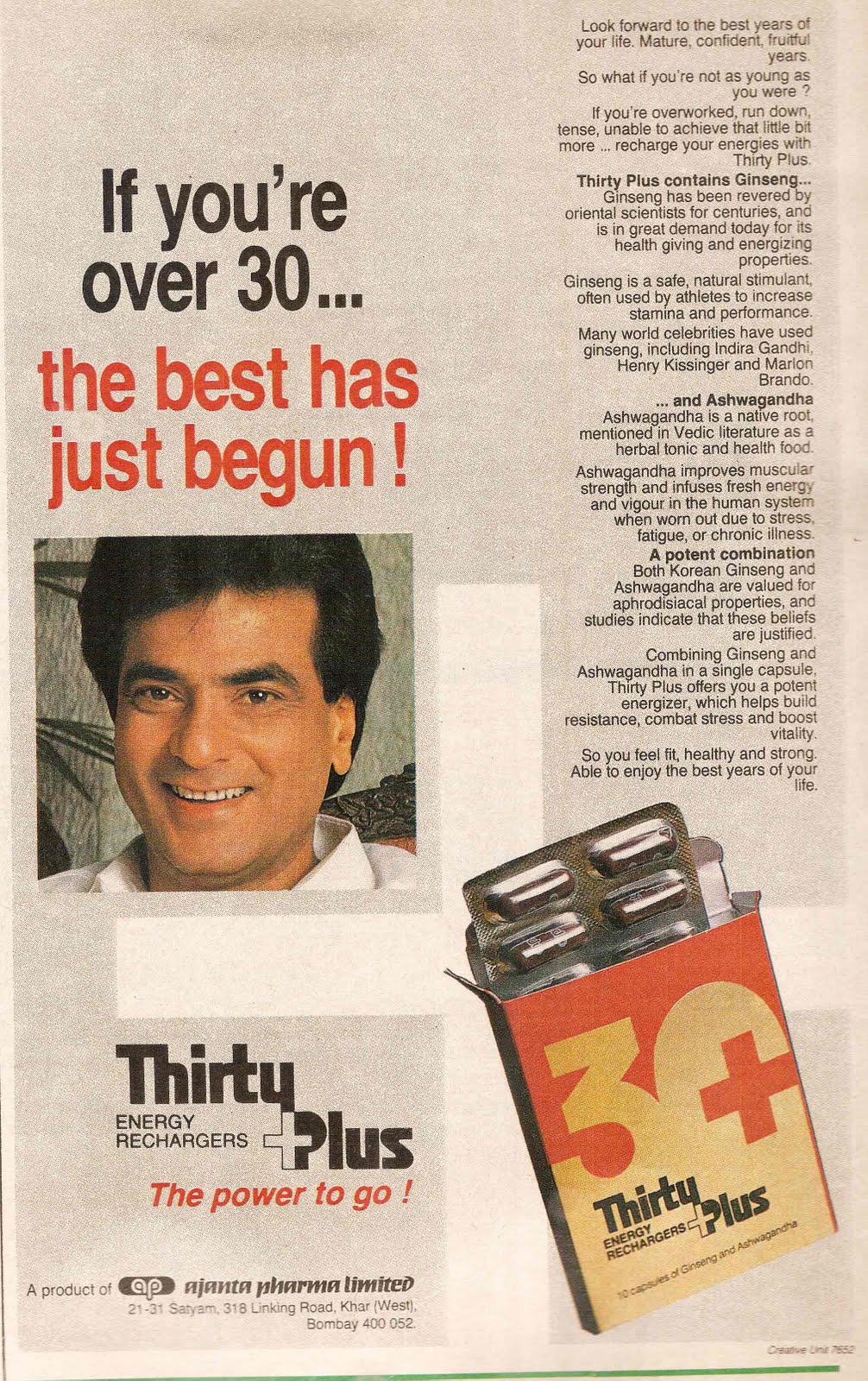
I crossed 30 last month, and that reminds me of the 30 plus ads featuring Jeetandra. Looks like the brand has been relaunched and positioned quite differently.
I came across this article critiquing the Nestle CEO on his views on water privatization:
In a candid interview for the documentary We Feed the World, Nestle Chairman Peter Brabeck makes the astonishing claim that water isn’t a human right. He attacks the idea that nature is good, and says it is a great achievement that humans are now able to resist nature’s dominance. He attacks organic agriculture and says genetic modification is better.
A comment on a wordpress reblog of the article lead me to an article by the CEO himself invoking the “tragedy of the commons” that quotes quite a few examples from India:
On the other hand, however, some at that time might have found the interpretation of a human right to water rather undifferentiated and radical. This rather extreme interpretation considered any withdrawal a human right and water as a free good. This interpretation is much less widespread today, but if accepted by more people, it could potentially have had serious consequences. The people defending this very extensive view were quite vocal, at times even aggressive. Whoever wanted to set a focus and add some more clarity here – and I was among those – was attacked.
That in turn reminded me of an article from 1982 regarding the way the diamond trade evolved to make diamonds a status symbol. The objectives were probably quite different, but notice any similarities with the water privatization solution?
The diamond invention is far more than a monopoly for fixing diamond prices; it is a mechanism for converting tiny crystals of carbon into universally recognized tokens of wealth, power, and romance. To achieve this goal, De Beers had to control demand as well as supply. Both women and men had to be made to perceive diamonds not as marketable precious stones but as an inseparable part of courtship and married life. To stabilize the market, De Beers had to endow these stones with a sentiment that would inhibit the public from ever reselling them. The illusion had to be created that diamonds were forever — “forever” in the sense that they should never be resold.
I guess the US Senate hasn’t changed all that much in over 70 years:
In Mr. Smith Goes to Washington, however, the decent common man is surrounded by the most venal, petty, and thuggish group of yahoos ever to pass as decent society in a Capra movie. Everyone in the film — except for Jefferson Smith and his tiny cadre of believers — is either in the pay of the political machine run by Edward Arnold’s James Taylor or complicit in Taylor’s corruption through their silence, and they all sit by as innocent people, including children, are brutalized and intimidated, rights are violated, and the government is brought to a halt”.
via Mr. Smith Goes to Washington – Wikipedia, the free encyclopedia.
I was pretty disappointed that I was not as disappointed by the Chashme Baddoor remake as I had anticipated from the promos. In fact, I had planned on skipping the movie altogether, but ended up watching it based on my parents recommendations. Also, the fact that Rajeev Masand gave it a fairly positive review helped (my tastes seem to line up with his on most Hindi movies). Also, just to make get my frame of reference right, I followed up the remake with the evening show of original classic.
So, here are my thoughts as usual:
Bottom line is that the remake is a typical David Dhawan entertainer where you can give rest to the grey cells, while the original remains a classic and seeing it on the big screen was a unique experience.
Wonder whether this will prompt Google to give a similar treatment to Android with Google+ and its plethora of services? Or “better” yet, to the next Nexus device. After the Google+ification of search, anything’s possible.
But that’s hardly the entire phone market. It’s actually only a fraction of it.
- What about those millions of people who have bought Android phones — and some iPhones, probably — who don’t really care that they’re Android phones, or even smartphones?
- The types of people who, every couple of years, go into the Verizon or AT&T shop and walk out with whatever newish thing the store rep says they should buy? (All those people who buy Android phones but don’t really show up in usage logs.)
- Or even first-time smartphone buyers?
My guess is that many — most? — of these people are Facebook users, and could easily see some utility in having Facebook features highlighted on their phones. And — bonus — Facebook’s software looks good. Much better than the junk that ships with typical low-end Android devices.
There is a reason why Apple has better things to do than create gags on April 1:
Apple was established on April 1, 1976, by Steve Jobs, Steve Wozniak and Ronald Wayne to sell the Apple I personal computer kit.