-
Quite a few useful links given in the article.
"The future of music over the next ten years depends on finding the right mix between “free” and “paid,” luring fans away from file sharing networks by offering them services that are faster, easier, and more convenient without asking them to subsidize the industry’s return to CD era profits." -
A useful list of advantages & disadvantages along with some basic description of DSLRs.
-
Now this is a way to publicise a wedding, with a poster, trailer et al. And don't forget the multi-layered, multi-flavoured cake either.
Author: Aditya
-
links for 2009-10-26
-
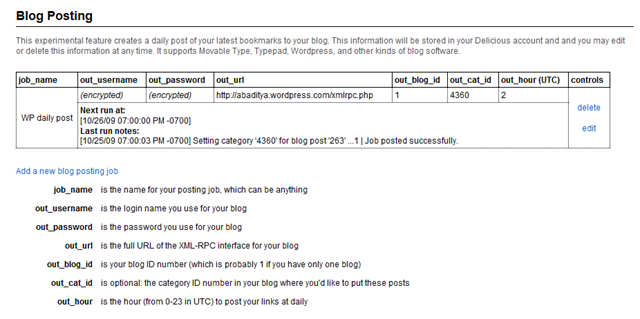
Return of the daily links from delicious
By now you have probably noticed that I’ve reverted to posting daily links from delicious to my blog (this time with more description hopefully) even though I had thought at one point in time that they were cluttering up my blog. One of the main reasons I did this was to keep the blog active as I seem to be bookmarking & twittering a lot more nowadays, and don’t make the time to come up with lengthier blog post.
Quite a lot of water has flowed under the bridge during this period, of which the most notable change is the new delicious interface going live. The other handy feature is the ability to post to twitter and email contacts while bookmarking through the firefox extension. I also refreshed my memory for posting from delicious through this blog post on posting to wordpress from delicious and also noticed that Steve Rubel had recommended daily links post as an essential blogging hack (too bad I gave it up for over a year and a half). So, now the daily links posts are here to stay.

Another thing I noticed while setting up the delicious service was that they’ve tweaked the interface slightly. Now the password field is no longer plain text (whatever made them do that in the initial phase is a mystery to me), and there is a way to effectively utilize the category field to keep the bookmark posts organized. All you need to do is figure out the category id by going to the wordpress blog dashboard –> Posts –> Categories to view the list of categories in the blog. Each category is hyperlinked (something like ….wordpress.com/wp-admin/categories.php?action=edit&cat_ID=4360) and the last portion of the URL gives the category id (out_cat_id in delicious). In my case, 4360 is the id for the “bookmarks” category that I had created for such posts. The setup is pretty convenient & should help keep the blog active in some way till I finish my Management course next year.
-
links for 2009-10-25
-
geek.menu is a fork of the portableApps.com menu system. It has many enhanced features (a complete list is available here such as support for:
* truecrypt
* categories
* custom buttons
* multi wallpaper switching
* auto-executing apps on start
* ejection scripts
* special behavior for authorized PCs
* local/www searchbar
via http://lifehacker.com/5389421/five-best-portable-apps-suites -
Gorgeous! Fire breathing videos captured in 1000+ fps for viewing in super slow motion. Currently only low res version is present. via http://www.boingboing.net/2009/10/25/super-slomo-fire-bre.html
-
Lupo PenSuite is a completely free suite of portable programs and games. This Suite is designed to simplify the user's life, by collecting the best suites and portable applications available on the Web.
Optimized to be loaded on a USB flash drive and brought always with you, this Suite works perfectly well on any other device. It includes over 200 highly selected portable programs and games (7-Zip, Audacity, CCleaner, eMule, FileZilla, Firefox, Foxit Reader, GIMP, IrfanView, Notepad++, Opera, Pidgin, Thunderbird, µTorrent, VLC and many more). -
A handy open source file renaming utility
-
A handy portable applications suite – includes multimedia, disk management, internet, productivity, security & utility software. Perfect fit for a thumb drive. Comes in 3 flavours ranging from a 56 MB setup to 186 MB.
-
Crowdsourcing at its best! What happens when you let loose crazy Star Wars fans on a remake project of the movie? You get a ton of 15 second clips that get put together to recreate the original. It's a work in progress though.
-
What happens when X-men meets peanuts or He-man meets Garfield. A really interesting & innovative take on comics.
-
A couple of workarounds for the high CPU usage in the Online Armor firewall. The first solution seems to work for me. Hope they fix it some time. Hopefully it's not the second case with the nvidia drivers for me.
-
-
links for 2009-10-24
-
Interesting real-time simulation displays the CO2 emissions of every country in the world, as well as their birth and death rates.
-
Group of indie game developers, running a friendly competition every month. The rules: Make a game based on the month's theme, and don't spend more than 7 days. New games posted at the end of every month.
-
-
links for 2009-10-23
-
Yet no amount of checking and rechecking could account for a dismaying number of inconsistencies: In a little over 10 percent of cases, she just couldn’t reconcile her figures with those of the commission. Online commentary – http://timoelliott.com/blog/2009/10/blind-and-incompetent-justice-thanks-to-spreadsheet.html
-
Royalties from The Great Gatsby totaled only $8,397 during Fitzgerald’s lifetime. Today Gatsby is read in nearly every high school and college and regularly produces $500,000 a year in Scottie’s trust for her children.
-
-
Text to movie with Xtranormal & State
I created the above video as an introduction to HarIT, the Green IT event of Avenues 2009, the annual B-school fest of SJMSOM, my B-school. I used the text to movie service – Xtranormal. It is a handy and innovative service that allows you to make movies by literally placing words in the mouths of characters. It has been around for a few months now and it recently launched a desktop software for making movies called State.
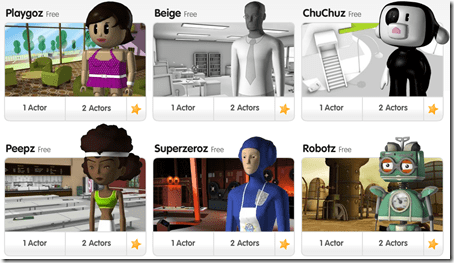
So, there are now two ways to make movies – one using the online service and two using the State software. The service is available in a basic and premium version. The basic version limits the number of actors, scenes & voices available. There are numerous worlds available online (see pic below) while the desktop software limits the worlds available but provides more actors, scenes & voices. The software is in beta and so is likely to change to be consistent with the online version.
The desktop software, State, requires you to have an account on Xtranormal and login before you can start using it. This is likely to regulate features available to free and premium members. It can be a bit of a problem to use the software if you are behind an authenticated proxy like me, as it does not load without logging in. It seems to use the proxy settings from Internet Explorer, but doesn’t prompt you for authentication. Due to this, it almost became a non-starter. However, I managed to find a workaround using a HTTP tunnel client that removes the need for authentication and sets up a local proxy address instead.

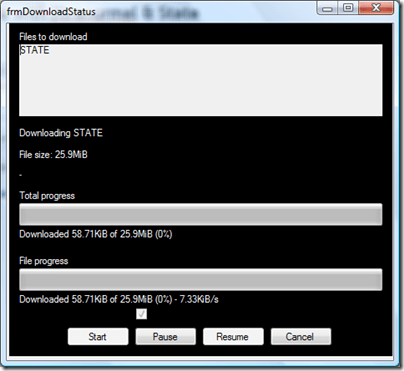
Since the software is in beta there are frequent updates, and upon logging in, you may find yourself facing an update window. When I was using the software the day before, it was prompting me for updates, but failed to download any of the files and later on, the prompts went away.
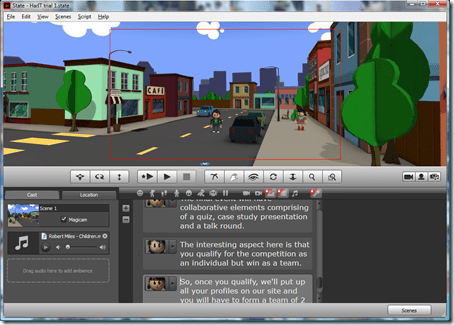
However, the software is quite easy to use (though pretty unstable – crashed many many times) and I managed to put together the video you saw on top in half a day. Not bad for a first time user eh? 🙂 It seems to support movie exports in 3 formats as of now (I used only the AVI option). It has support for background scores, character expressions, postures, movements, looking and lots more. There also seem to be a few placeholder elements in the interface indicating that there’ll be support for inserting videos and pictures along with the option of recording audio (or are those premium features?). In absence of these features as of now, I just exported an AVI file and then did some editing in Windows Live Movie Maker (another easy to use & handy product) to create the final piece.
Here’s a screenshot from the software:
One of the things that struck me while making the video was the level to which text to speech has progressed. Earlier, I remember the text to speech convertors spelling out words in case it did not have it built in. In State however, the words were handled phonetically. There were some limitations of course with the default spellings for some of the Indian words, but I solved them easily by going in for phonetic spellings. For example, HarIT was being pronounced as Har-I-T rather than Har-eet, and the latter is the spelling we used in the script to get the desired result. Similarly we also had to split facebook to “face book” to get the right pronunciation.
Overall, the service holds a lot of promise and if you look into the future, it’s only a matter of a few years before we’re able to create high quality animated movies from our personal machines. Just imagine directing well known characters yourself. That said, the online version seems to be having load issues as the number of users seems to have expanded quite a bit. The desktop version does addresses the availability problems of the online version, but the feature sets are not same across the two.
You can also check out the Xtranormal youtube channel to catch their latest movies.
-
Another year, another shift
And another round of classes begin in SJMSOM. In fact, they began last week itself (22nd July). This semester is filled with elective courses, and I’ve opted for Systems, Marketing and General Management courses. I’m also doing the Photo Communication course offered by the IDC, and it should be a useful learning. We’ve also kick-started our club sessions this week with experience sharing sessions from my batch. SOM11 has also joined, and they outnumbered my batch by almost a score. In fact the freshers’ party is scheduled this Sunday.
As for the shift that I mentioned, it was the hostel shift. The entire SOM senior batch was transferred from Hostel-1 to Hostel-13. So, all of us now have single rooms. I was one of the few to have enjoyed a single room in Hostel-1. This was due to a roof leak during the monsoons last year when my side of the roof started dripping and I moved out to another leak-free room. It is quite a coincidence that I once again ended up with a room closest to the bathroom. It does have its advantages I suppose. Hostel-13 is a pretty good place to be in though it is at the fag end of the campus. The bus passes come in handy over here and the mess (shared with Hostel-12) is also pretty good.
There are quite a few things lined up this semester other than the academics. We had the Finance and Marketing Continuum a couple of weeks ago. There’ll also be industry interaction sessions over the course of the semester along with the usual club meets. The big event will be AVENUES 09, our annual fest at the end of October. As of now, I’m helping out with the IT work and the IT event (HarIT). We’ve also started a twitter stream for our school that’s gaining traction gradually and we’re chalking out the policy and publicity strategy for it. It will definitely help us open up a new and more interactive channel for both the SJMSOM members and the external world. Let’s see how that goes.
-
Interning on FOSS 1: Open Source Development
I’ve been interning at Sun Microsystems in Delhi from May 1st and during this period, I’ve had the opportunity to research a variety of open source applications. My initial project was to explore and research various open source applications suitable for use by students and compare them against each other and with the proprietary alternatives. There are indeed a bunch of alternatives available for the software we use during the course of our day to day work.
I managed to submit a paper on “Components of an Open Source Operating System for Sustainable ICT Education in Schools in Developing Countries” to the HICSS conference, and I’m starting off a multi part post with my learnings on open source software and development.
One of the interesting works that I read on open source development was Eric Raymond’s “The Cathedral and The Bazaar”. This is probably one of the definitive works on open source development, and a number of theories stem from it. In fact, quite a few papers that I referred to during the course of my research cited this work. He has postulated the following principles in the essay:
-
Every good work of software starts by scratching a developer’s personal itch.
-
Good programmers know what to write. Great ones know what to rewrite (and reuse).
-
Plan to throw one away; you will, anyhow.
-
If you have the right attitude, interesting problems will find you.
-
When you lose interest in a program, your last duty to it is to hand it off to a competent successor.
-
Treating your users as co-developers is your least-hassle route to rapid code improvement and effective debugging.
-
Release early. Release often. And listen to your customers.
-
Given a large enough beta-tester and co-developer base, almost every problem will be characterized quickly and the fix obvious to someone. (The full version of Linus’s law – Given enough eyeballs, all bugs are shallow)
-
Smart data structures and dumb code works a lot better than the other way around.
-
If you treat your beta-testers as if they’re your most valuable resource, they will respond by becoming your most valuable resource.
-
The next best thing to having good ideas is recognizing good ideas from your users. Sometimes the latter is better.
-
Often, the most striking and innovative solutions come from realizing that your concept of the problem was wrong.
-
Perfection (in design) is achieved not when there is nothing more to add, but rather when there is nothing more to take away.
-
Any tool should be useful in the expected way, but a truly great tool lends itself to uses you never expected.
-
When writing gateway software of any kind, take pains to disturb the data stream as little as possible—and never throw away information unless the recipient forces you to!
-
When your language is nowhere near Turing-complete, syntactic sugar can be your friend.
-
A security system is only as secure as its secret. Beware of pseudo-secrets.
-
To solve an interesting problem, start by finding a problem that is interesting to you.
-
Provided the development coordinator has a communications medium at least as good as the Internet, and knows how to lead without coercion, many heads are inevitably better than one.
Most of his principles are for software development in general, and so also apply to open source development. The key learnings form his essay are two-fold. First is that it is important to have a working prototype of the project before making it open source, or at least trying to find other developers who’d be interested in it. Second is that open source attracts a wide variety of talent that can be put to various uses, ranging from bug finding, to improvement suggestions to actual coding. Thus, it is essential to treat the participants in the right manner as everyone could make an important contribution.
One of the other observations to be made about open source development is the vital role that the internet has played in creating the synergy that exists between the developers, users and other contributors of any open source project. In fact, Eric Raymond has said as much in his essay:
… Another (in hindsight) was that the Internet wasn’t yet good enough.
Before cheap Internet, there were some geographically compact communities where the culture encouraged Weinberg’s “egoless” programming, and a developer could easily attract a lot of skilled kibitzers and co-developers. Bell Labs, the MIT AI and LCS labs, UC Berkeley—these became the home of innovations that are legendary and still potent.
Linux was the first project for which a conscious and successful effort to use the entire world as its talent pool was made. I don’t think it’s a coincidence that the gestation period of Linux coincided with the birth of the World Wide Web, and that Linux left its infancy during the same period in 1993–1994 that saw the takeoff of the ISP industry and the explosion of mainstream interest in the Internet. Linus was the first person who learned how to play by the new rules that pervasive Internet access made possible.
In essence, open source development has a lot of potential when used in the right manner. In fact, many companies use it quite strategically and couple them with interesting licenses (I’ll cover licenses in another part). There are also quite a few organizations championing free (as in freedom) software with the FSF (Free Software Foundation), headed by Richard Stallman being one of the pioneers. There is also a bit of controversy in the Free/Open Source world with some preferring the term free to open source. This has however not deterred organizations from leveraging open source development strategically. Open source development may not be practicable in every situation, particularly for routine software development in enterprises, but it definitely has its merits and I’ll be looking at other aspects of open source software in subsequent parts.
-
-
Revisiting University 2.0
It has been a while since I dwelled on the University 2.0 topic. In fact, I had given a presentation in one of the Systematics club (our Systems club) meetings in SJMSOM. We managed to grab a video of the session, and here it is.