Tag: artificial-intelligence

  • What “AI-native” actually means for a founder-led firm

    What “AI-native” actually means for a founder-led firm

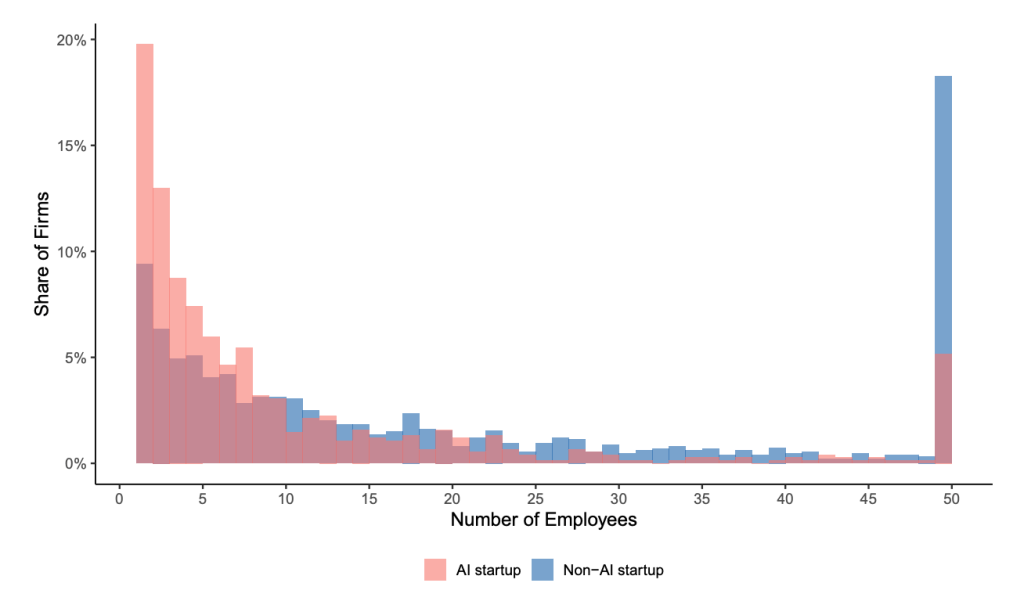
    A recent paper from INSEAD and Harvard looked at close to 3,000 startups and found something that should interest anyone running a small firm. Matched like-for-like, same industry, same age, the ones built around AI ran about a quarter smaller than the ones that weren’t. In services, the gap reached roughly 70%. Fewer people, the same kind of work, and not because they were starving themselves of staff.

    A smaller firm that is worth more

    Across eleven startup batches from 2020 to 2024, the AI-native firms ran leaner and flatter, carried more senior people and fewer managers, and still raised more money and held higher valuations per head than their peers. The smaller size was buying more output per person, not papering over weaker companies. The effect was largest, near 70%, in services firms, the advisory-and-delivery work many of us sell. If your firm sells judgment rather than a shipped product, that number is aimed at you.

    One example makes the shape concrete. An AI slide-deck company reached around $50M of annual revenue in about two years with a team of roughly 30, because making a deck became something the customer does inside the product instead of a job that lands in someone’s queue. A small team, a lot of output, because the work itself moved.

    A fair caveat, which the paper makes and most write-ups drop: a leaner firm need not mean fewer jobs overall. Cheaper output tends to pull in more demand for it (the Jevons paradox: make something cheaper and we usually use far more of it), so the economy can end up with more firms and more total work even as each one shrinks.

    The most telling result is one that didn’t show up the way you might expect. The AI-native firms in the study were about 2.6 times more likely than the rest to name worker-facing tools (ChatGPT, coding assistants, and the like) in their job ads, yet that heavier tool use predicted none of the structural differences: not the smaller size, not the flatter hierarchy. As the authors put it, “equipping workers with ChatGPT, Copilot, or Cursor does not, on its own, predict smaller firms.”

    A large MIT study in 2025 found the mirror image: around 95% of corporate AI pilots delivered no measurable impact, with the failures traced to organisations bolting AI onto existing workflows rather than to the technology itself. Both point the same way. The gains come from redesigning the work, and the licence count barely matters.

    What did track with firm size was where the AI sat. Used inside the firm to speed up work people already do, it moved the structure very little. Built into what the firm sells, so the customer generates the output directly, it tracked with the shrinkage. It is the same move Ben Thompson called an unbundling: the firms that pull ahead fold the act of making something real into the product, rather than keeping it a step their staff perform.

    Governed delegation

    What makes a firm AI-native, then, is how far it has rebuilt its work around what AI can do reliably and what still needs a person watching. Call it governed delegation: you hand the work to AI while keeping your hands on the rules, the boundaries, and the checking. Think of a restaurant that buys a dishwasher but keeps everyone rinsing each plate by hand first. It has added a machine and kept the old routine, so all it has really bought is cost. The gain shows up only when the workflow is rebuilt around what the machine does well.

    Most of this conversation stays inside software teams, which is why the wider point gets missed. The same logic runs straight into sales, marketing, and operations, which is where I have spent the past several months testing it. I run most of OrchestratorAI’s own go-to-market this way: agents handle well-defined pieces of work, and my job is to set the rules and check the output rather than produce each piece by hand. Each group of agents runs in one of two modes, either nothing leaves the building until I have looked at it, or it runs on its own, shows me a sample, and escalates the exceptions. A task earns its way from the first mode to the second only after it stops throwing up things to fix, and some never do. Drafting a note to a high-value prospect stays under review; filling in a basic company profile from public sources does not need me hovering.

    Running it this way taught me something the paper doesn’t quite reach: almost none of the governance had to be invented. We have spent decades building ways to govern people at work: audit trails and compliance checks, standard operating procedures, the maker-and-checker split in finance, code review and the ceremonies of Agile. In a human-only firm a lot of this sits heavy. It adds layers and breeds box-ticking, because people dislike being audited and tire of the checklist, so the control gets watered down to what the organisation or regulators will tolerate.

    Point the same practices at AI agents and the weight largely lifts. An LLM is trained on how people work, so it takes direction roughly the way a person does, and the structure of the playbook carries over. The agent doesn’t resent the audit log or cut the SOP short when it’s busy, so a check that was costly to run on people is cheap to run on an agent. The procedures that were overhead in a human firm become the guardrails of an AI-native one. The autonomous SDLC (the software build-and-ship cycle, increasingly run by agents) is the clearest case I’ve come across: code review, the test gate, the staged rollout that always slowed teams down are exactly what lets an agent ship without a human reading every line.

    The one catch here is that agents fail differently from people. They don’t commit fraud or get bored; they fabricate confidently and come apart on inputs a person would laugh off. So the controls transfer in shape, not in detail: you keep the independent check and the earned trust, but you point them at hallucination and weak grounding rather than at fatigue and dishonesty. Those rough edges are being ironed out quickly. Coding is the clearest case, where agents have grown markedly more reliable over the past year, and making AI broadly more dependable and harder to misuse is a major focus at the frontier labs, still some way from solved. The upshot is that there is already plenty an agent can be trusted to do well today, and the list keeps growing.

    What it means if you run a small firm

    The paper names the real bottleneck, and it isn’t access to AI, which everyone now has at much the same price. It is the mapping problem: working out where, in your particular business, AI actually pays off. That has no generic answer, and finding it is the work that’s left.

    For a founder, the practical shift is that your scarce time moves from production toward direction and judgment, deciding where AI-handled work ends and where human review is non-negotiable. The closer you sit to pure services, the sharper that shift, which is presumably why the services number ran to 70%. Autonomy has to be earned, too: moving a task from supervised to self-running is a track record you build through logging and spot-checks, not a switch you flip. So the key question to put to your own firm is not which AI tools to buy, but which parts of the work can be governed at the boundary, and which still need a person on every output.

    None of this is settled, and the unsettled part is the interesting one: deciding when a piece of work has earned its autonomy, and building the checks so you aren’t flying blind once it runs alone. Strikingly few firms in the data had actually managed it, which makes “AI-native” more aspiration than description for now, even among the companies wearing the label. That is the encouraging part. The tools are here and roughly evenly spread, so the advantage goes to whoever does the slow, unglamorous work of deciding what to hand over and what to keep a hand on.

  • Turning 42, and Coming Full Circle

    Turning 42, and Coming Full Circle

    I turned 42 this year. I don’t usually attach much meaning to birthdays, but this one did trigger a quiet pause—not a reinvention, not a reset, just a sense of recognition. A feeling that certain instincts and interests I’ve carried for a long time were finally meeting the right conditions to be acted upon.

    In many ways, it felt like coming full circle. Post–IIT Bombay, I had toyed with the idea of building something of my own more than once, but the timing never really worked. The cost of experimentation was high, the downside felt asymmetric, and meaningful execution required a kind of commitment—in time, capital, and headspace—that didn’t quite align with where life was then. AI didn’t create those ambitions. It removed enough friction that acting on them no longer felt irresponsible.

    There’s a popular mental model floating for AI—the Star Trek computer. Voice interface, simple commands, complex tasks executed seamlessly. It’s appealing: tell the AI what you want, and it handles the messy details. But we don’t have that yet. What we have now is quite powerful but far messier—and that gap between expectation and reality matters.

    Looking back, this arc probably started earlier than I realized. What felt like casual tinkering at the time—experimenting with tools, workflows, and ways of interacting with information—was really the beginning of a longer loop of building, reflecting, and writing.

    The first half of the year was deliberately focused inward. The arrival of our newborn changed the rhythm of everyday life in fairly fundamental ways. Time became scarcer, but priorities became clearer. Decisions that once felt nuanced or debatable started resolving themselves quickly when viewed through the lens of family well-being and long-term sustainability.

    Around the same time, we moved from Dubai back to Mumbai. On paper, it was a relocation. In practice, it was a broader reset—of cost structures, support systems, and optionality. Some things became simpler, others more complex, but overall it created a sense of grounding that had been missing.

    In hindsight, the first half wasn’t a slowdown so much as an incubation period. That stability mattered more than I realized at the time, because once the personal base felt settled, professional decisions became easier to make—and easier to commit to. The questions that kept surfacing during this phase were telling. Education, work, and what we’re really preparing the next generation for stopped feeling abstract and started feeling personal. Agency matters more than intelligence—the capacity to take initiative, make things happen, shape your path rather than wait for it. Are we educating for that? It’s a question that feels more urgent when you’re thinking about your own child’s future.

    The second half of the year marked a clear shift from exploration to ownership. I chose to go down the solo path, not because it’s easier, but because at this stage it offers speed and coherence. Fewer dependencies, tighter feedback loops, clearer accountability.

    AI changed the feasibility equation in a very real way. What once required teams and capital can now be prototyped solo—not perfectly, but fast enough to learn. Over time, this also changed how I approached building itself, gravitating toward a more fluid, iterative style where intent and execution sit much closer together.

    That conviction led to formalizing OrchestratorAI. Registering the company and filing the trademark weren’t about signaling externally as much as they were about drawing a line for myself. This wasn’t just advisory work or experimentation anymore; it was something I wanted to build patiently and seriously.

    A lot of the focus naturally gravitated toward the long tail—especially MSMEs. Large enterprises will adopt AI, but slowly and expensively. Smaller businesses can leapfrog. The marginal cost of intelligence has dropped enough that problems once considered too small or not worth solving suddenly are. That idea kept resurfacing as I looked at broader patterns in work, strategy, and go-to-market, often in ways that felt far messier in practice than in slides.

    Completing a year self-employed felt like its own milestone—not because of what I’d built yet, but because I’d committed to the path.

    Three things that have crystallized

    This is a great time for builders—not for shortcut-seekers.

    There’s a popular narrative that AI is about doing less work—the Star Trek computer fantasy where you state your intent and complex systems just work. My experience has been the opposite. We don’t have the Star Trek computer. AI rewards those willing to go deeper, not those trying to bypass fundamentals.

    Tools amplify intent and effort; they don’t replace them. The gap between “prompting” and actually building systems—workflows, artifacts, and feedback loops—is widening.

    Jevons’ Paradox is no longer theoretical in knowledge work.

    Making intelligence cheaper doesn’t reduce the amount of work; it expands it. Lower costs unlock suppressed demand—more ideas get tested, more workflows get built, more edge cases start to matter.

    Entire categories of previously unsolvable problems suddenly become economically viable. We’re even seeing fundamental business model shifts—from selling seats to selling outcomes, from “buy software” to “hire agents.”

    This is the foundation of what I’m building: serving markets that were previously uneconomical to serve.

    A lot of old ideas are finally working the way they were meant to.

    State machines, artifact-centric design, structured workflows, even the promise of auto-coding—none of these are new concepts. What’s new is that the economics finally make sense.

    But there’s also a new layer to master. Programmers now need mental models for agents, subagents, prompts, contexts, tools, workflows—a fundamentally new abstraction layer intermingled with traditional engineering.

    Abstractions still leak, and much of the year’s noise around agentic coding oscillated between hype and reality before settling. What’s emerging: structure matters, and there’s a real shift as agents become central to how work gets done.

    One curious footnote

    Starting in September, I noticed an unusual spike in traffic to my blog—specifically to posts from 10-15 years ago. The pattern was unmistakable: China. Most likely LLM training runs scraping old content at scale.

    There’s something quietly amusing about that timing. While my decade-old posts were feeding tomorrow’s AI models, I was using today’s AI to finally act on ideas I’d shelved post-IITB. Full circle, in an unexpected way.

    2026 feels different. Not because the work gets easier, but because the constraints are clearer. Family grounded, venture formalized, year one complete.

  • From Clicks to Conversations: How AI Agents Are Revolutionizing Business

    From Clicks to Conversations: How AI Agents Are Revolutionizing Business

    For the last decade, businesses have invested heavily in “Digital Transformation,” building powerful digital tools and processes to modernize their operations. While this era brought significant progress, it also created a persistent challenge. The tools we built—from CRMs to ERPs—were largely dependent on structured data: the neat, organized numbers and categories found in a spreadsheet or database. Computers excel at processing this kind of information.

    The problem is that the most valuable business intelligence isn’t structured. The context behind a business plan locked in a 100-slide presentation, the nuance of a customer relationship captured in a rep’s notes, or the true objective of a strategy discussed in a meeting—this is all unstructured data. This divide has created a major hurdle for business efficiency, as great ideas often get lost when people try to translate them into the rigid, structured systems that computers understand.

    The Old Way: The Limits of Traditional Digital Tools

    The first wave of digital tools, from customer relationship management (CRM) software to accounting platforms, were designed for humans to operate. Their critical limitation was their reliance on structured data, which forced people to act as human translators. A brilliant, nuanced strategy conceived in conversations and documents had to be manually broken down and entered into rigid forms and fields.

    This created a significant “gap between business strategy and execution,” where high-level vision was lost during implementation. The result was heavy “change management overheads,” not just because teams needed training on new software, but because of the cognitive friction involved. People are used to working with the unstructured information in their heads; these tools forced them to constantly translate their natural way of thinking into structured processes the software could understand.

    Information TypeBusiness Example
    StructuredEntries in a CRM database, financial data in an accounting platform, inventory numbers in an ERP system.
    UnstructuredA 100-slide brand plan document, a sales rep’s recorded notes describing a doctor they just met, emails discussing a new brand strategy.

    This reliance on structured systems meant that the tools, while digital, couldn’t fully grasp the human context of the work they were supposed to support. A new approach was needed—one that could understand information more like a person does.

    A Smarter Way: Introducing AI Agents

    Welcome to the era of “AI Transformation.” At the heart of this new wave are AI Agents: specialized digital team members that can augment a human workforce. Think of them as a dedicated marketing agent, a sales agent, or a data analyst agent, each designed to perform specific business functions.

    The single most important capability of AI agents is their ability to work with both structured and unstructured information. You can communicate a plan to an agent by typing a message, speaking, or providing a document—just as you would with a human colleague. This fundamental shift from clicking buttons to holding conversations unlocks three profound benefits:

    • Bridging the Strategy-to-Execution Gap: AI agents can understand the nuance of an unstructured plan—the “why” behind the “what”—and help execute it without critical information getting lost in translation.
    • Handling All Information Seamlessly: They can process natural language from documents, presentations, or conversations and transform it into the actionable, structured data that existing digital tools need to function.
    • Reducing Change Management: Because agents understand human language, the need for extensive training on rigid software interfaces is significantly reduced. People can work more naturally, supervising the agents as they handle the tedious, structured tasks.

    To see how this works in practice, let’s walk through how a team of AI agents can help plan and execute a marketing campaign from start to finish.

    AI Agents in Action: Launching a Marketing Campaign

    This step-by-step walkthrough shows how AI agents can take a high-level marketing plan from a simple idea to a fully executed campaign, seamlessly connecting unstructured strategy with structured execution.

    1. The Starting Point: The Marketing Brief – The process begins when a brand manager provides a marketing brief. This brief is pure unstructured information—it could be a presentation, a document, or even the transcript of a planning conversation. It contains the high-level goals and vision for the campaign.
    2. Deconstructing the Brief: The Brand Manager Agent – A specialized “Brand Manager” agent analyzes the unstructured brief and extracts the core business context elements. It identifies key information such as:
      • Business objectives
      • Target audience definitions
      • Key messages
      • Brands in focus
      • Timelines and milestones
    3. The agent then organizes this information into structured, machine-readable “context blocks,” creating a clear, logical foundation that other systems and agents can use.
    4. Understanding the Customer: The Digital Sales Agent – Next, a “Digital Sales” agent contributes by performing customer profiling. It can take unstructured, natural language descriptions of customers (for instance, from a sales rep’s recorded notes) and map them to formal, structured customer segments and personas. This builds a richer, more accurate customer profile than a simple survey could provide.
    5. Creating the Content: The Content Writer Agent – Using the structured business context from the Brand Manager agent, a “Content Writer” agent assembles personalized content. It can reuse and repurpose existing content from a library of approved modules, accelerating content creation while ensuring brand compliance.
    6. Executing the Plan: The Next Best Action (NBA) Engine – Finally, the system brings everything together to recommend the “Next Best Action.” This engine synthesizes the campaign’s business context, the customer’s profile, the available content, and their recent engagement history to suggest the perfect next step for each customer. It recommends precisely what content to send and which channel to use, turning high-level strategy into a concrete, personalized action.

    This orchestrated workflow makes the entire process smoother, faster, and far more intelligent. It creates a virtuous cycle, where the system learns from every interaction to continuously improve the overall strategy and execution over time.

    The Future of Work is Collaborative

    The rise of AI agents marks a fundamental shift in how we work with technology. We are moving from a world where humans must adapt to operate digital tools to one where humans supervise intelligent AI agents that use those tools on our behalf.

    This new wave of AI transformation is not about replacing people, but about augmenting their human workforce without adding headcount. By handling the translation between unstructured human ideas and structured digital processes, AI agents help businesses reduce friction, cut down on turnaround times, and finally bridge the long-standing gap between their biggest strategies and their real-world execution.