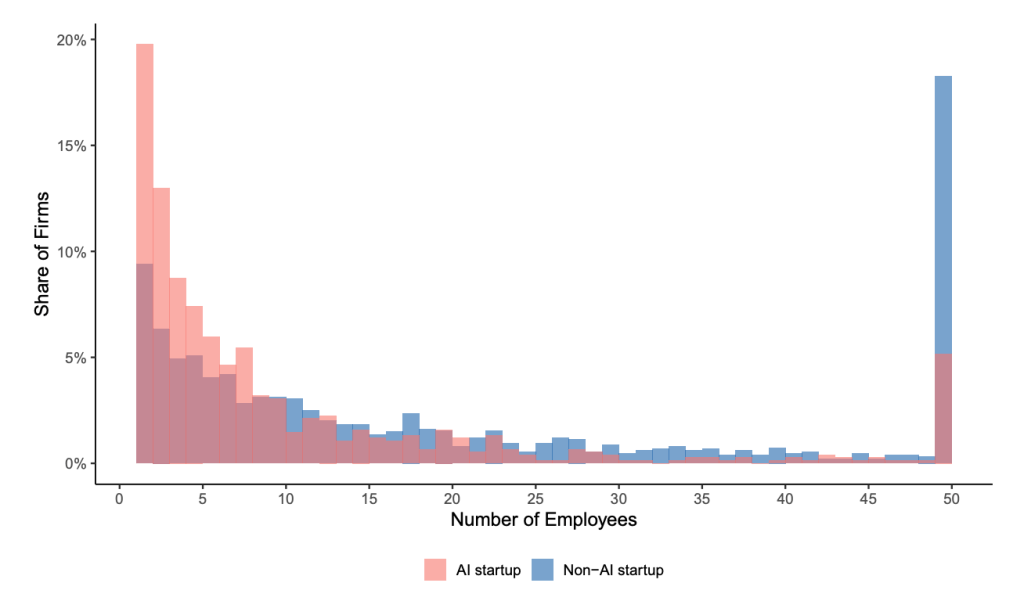
In the last piece I looked at what actually separates AI-native firms from everyone else, and one finding has been nagging at me since. The study behind it found these firms were flatter as well as leaner: more senior people, fewer managers, matched like-for-like against their peers. I reported that without really explaining it. Economists have held since Coase in 1937 that a firm’s shape follows its coordination costs, and AI is plainly moving those. But that finding is about the inside of the firm. And the inside only makes sense one level below the org chart, at the smallest unit a company is assembled from: the worker, and what one worker can now carry.
The worker, renamed
Nearly seventy years ago, Peter Drucker renamed the atomic unit of work. The knowledge worker was his label for people whose output is thinking, and the renaming mattered because everything eventually reorganised around it: the office, the KPI, the annual review, the one-on-one. It took decades, but the way we run companies today is the machinery we built to manage the unit Drucker named.
We’re due another renaming, and my working label is the AI-native worker: a person, a knowledge worker who runs their patch of the organisation through a set of AI tools and agents, and who owns the outcome the way a manager once owned a team’s. The durable thing is the worker, and the discipline they run; the agents themselves are mostly ephemeral, spun up for a task and discarded after (my research setup, for instance, assembles the evidence on a named prospect, reads anything public, sends nothing, and might be rebuilt from scratch next month).
The deeper change is in what the role contains. For a century we ran a deliberate split: managers decided what to do and how it should be done, and the front line did it — scientific management made that split official policy. The AI-native worker compresses the stack back together. They set the direction, decide the how, and orchestrate agents that do the doing. Drucker saw the first half of this coming when he argued that knowledge workers can’t be supervised in the old way and must manage themselves; the tools have now supplied the second half. Judgment and execution end up in the same hands again, which is where they sat before the split.
Process automation with better branding, then? Not quite, and the reason takes the rest of this piece.
The dial and the span
Last time, I described running my own go-to-market on two modes: either nothing leaves the building until I’ve looked at it, or the work runs on its own and shows me samples. That was a simplification. The fuller picture is a dial with positions along it: approve every step; watch and sample while the work runs; set direction and audit the record afterwards. Think of it as a dimmer, not a switch. Each task a worker hands to their tools sits somewhere on that dial, and the worker sets the position — moving a task down the dial is something a tool earns, on track record it can point to.
In my own pipeline the same work has moved along the dial as the tools proved themselves: the research loop once ran with me approving each output, and now runs ahead of me with spot-checks. The call on whether a prospect is qualified hasn’t moved at all, and likely won’t (some decisions I simply want to make myself). Both sit inside one person’s remit. The dial only says how much of the doing gets handed off, and for some of it the honest answer is none.
The old rule of thumb was that a manager could handle five or six direct reports (a number honoured mostly in the breach), because supervising people means conversations, meetings, and reading a room, and those relationships multiply faster than headcount. Most organisational pyramids are simply that arithmetic made visible. But supervising tool-work is different: you read a work record, sample outputs, and handle what gets handed up. One worker can run far more of it than anyone ever could direct reports, and the ceiling that produced the pyramid stops binding.
There is a deeper reason the pyramid thins. Strip management to its core function and much of it is answering questions: the front line handles the routine, and whatever it can’t answer moves up to someone with broader knowledge. A layer exists because those questions exist. Put the answer at the point where the problem occurs, which is much of what AI does, and the questions stop travelling upward. The layer that lived on them has nothing left to do. (Nicolai Foss walks through the economics of this, for anyone who wants the theory.) The same logic runs sideways: a worker who covers a workflow end to end leaves no handoffs to manage. Software had a preview of this long before AI — some engineers were worth ten, and famously couldn’t be replaced by ten. Leverage concentrates in the people who wield their tools well, and that pattern is no longer confined to software.
Which is, I suspect, exactly what that flatter-firms finding was measuring. The coordination work that fills much of middle management (collecting status, relaying context, scheduling the work of others) is the part that compresses first. If that work is the bulk of what you do, it can feel like there will soon be nothing left to do. What remains, though, is more hands-on than the job it replaces: direction, judgment, exceptions, and the running of the work itself.
This is no longer speculation about the headlines, either: Oracle, Meta and a growing list of large employers have explicitly cited AI in this year’s job cuts, though few of them describe what changed in span-of-control terms. Microsoft’s Work Trend Index calls the destination human-agent teams with every employee expected to direct agents rather than do all the doing themselves. Wherever the labels settle, the shape is consistent: fewer people, each carrying more, each closer to the actual work.
Lean around what you’re best at
If one worker can carry more, the question becomes what they should carry. C.K. Prahalad and Gary Hamel answered this more than thirty years ago: organise around your core competence, the few things you’re distinctively good at. AI sharpens that old advice, because once the routine frictions fall away, the constraint that remains is judgment, and your judgment is only worth a premium where your competence is. The same holds one level down: an AI-native worker leans out the way an AI-native firm does, concentrating on the work where their judgment is differentiated and pushing everything else to tools, or to whoever already does it better. Which cuts against the current fashion for pulling everything in-house because building got cheap. Build where your judgment is the ingredient: the thin layer shaped around work only you do that way. Improvise your own version of everything, though, and you end up with a portfolio of systems nobody truly owns, and the governance bill arrives later. Cheap building sharpens the buy-versus-build question rather than settling it.
One record everyone reads
None of this survives contact with reality without one more piece, and it’s the one traditional organisations never managed to build. When an experienced colleague resigns, what walks out with them is rarely written anywhere: which client dislikes calls before ten, why the pricing was structured that way, what was tried in 2023 and quietly abandoned. Drucker saw this coming too; knowledge work runs on know-how that is hard to write down, which is precisely what makes an organisation fragile when people leave. We preached the single source of truth for decades and never had one, because keeping it current was rote work, and it was nobody’s real job.
An AI-native worker can’t run any other way, so the fix gets forced. All the work runs out of a shared, plain-language record: decisions, drafts, handovers, and the reasoning behind them land there as a by-product of doing the work, with no documentation step bolted on afterwards. The agents remember nothing between tasks; the record is the memory. And plain language is the interface: the same written brief that would bring a new colleague up to speed is what briefs an agent, and the record an agent leaves behind reads like a colleague’s notes. So the know-how that used to live in heads finally has somewhere to sit, and it stays current because everyone, human or tool, works from it daily.
The record earns its keep twice over. It is what keeps coordination cheap as one worker’s reach grows; without it, the savings leak back out as interruptions, and the old coordination bill walks straight back in. It is also where this series goes next: software shaped around the exact work, and handoffs someone actually designed.
Not the automation you remember
The automation wave most businesses remember automated keystrokes: scripts that clicked through screens, brittle the moment an invoice format changed, readable only by the IT department. It could only ever hold work you could spell out step by step, which is why it stayed at the edges of the organisation. This is a different proposition, and the difference is the package: a worker who owns outcomes across both the step-by-step work and the judgment calls, a dial that sets how much oversight each task gets, and one plain-language record that people and tools alike read and write. Take away any one of the three and you’re back to a slightly better version of the old automation. Together they form a new operating layer for the organisation, which is a different ambition from building software faster.
One question stays open, and it’s the one Drucker spent his career on: how do you measure this kind of worker’s productivity? The full work record makes quantity temptingly easy to count, and the corporate world just ran that experiment. The “tokenmaxxing” fad, measuring people by how much AI they used, in one case running an internal competition to reward it, rose in spring and was being walked back by summer, as costs climbed without the productivity to show for them. One CTO compared it to grading programmers on lines of code. Outcomes per role are the honest measure, and defining the role is the harder half.
The workers exist, the dial is in daily use, and the pitch from the providers themselves has been shifting from assistants you chat with toward agents you delegate to and oversee. What’s still forming is the discipline around it, and that part, pleasingly, is management work: deciding what a role owns, what its tools may touch, where on the dial each task starts, and what counts as doing well. Somewhere in your own week there’s a stretch of work defined tightly enough to hand to the dial tomorrow. Assume the tools could do it; the question worth sitting with is where on the dial you’d be willing to start, and what it would take to earn the next notch.