Category: Thoughts

  • HTC One V: 2 week usage review

    Update (17 Aug 2012): My HTC One V died last month (in less than 3 months), and by died I mean totally bricked just sitting in my pocket – wouldn’t turn on or charge. This seems to be a fairly common problem with the initial batches of the phone. I changed my flipkart review due to this. In case you are wondering what the problems are, try searching these terms on Google: “HTC One V dead”, “HTC One V not turning on” & “HTC One V bricked”.

    Original review

    I finally gave up on the Android dead end (no ICS upgrade) that was my Galaxy S i9003 and decided to jump to the ICS bandwagon. The only options for an out of the box ICS experience in India at this time are the HTC duo – One X & One V. Of these, the One X was beyond my budget, and so it was a pretty simple decision to go for the One V in the end.

    Reviews have been pretty positive, and I’m throwing in my 2 cents based on a 2 weeks of usage experience that wouldn’t have shown up in initial reviews. A caveat on my usage experience – I use the One V (and the Galaxy S before it) primarily as a mobile internet device (mails, browsing, e-commerce, social networking etc.) rather than for phone calls.

    What did I get over the Galaxy S i9003?

    The build quality is definitely impressive with the metal body, and it is also sleeker than the Galaxy S. I personally prefer the One V’s build quality over the Galaxy S.

    In terms of software, ICS definitely offers a better experience than Froyo (there is a Gingerbread update for the Galaxy S, but I never got to install that during my 1 year with the phone – Kies didn’t work, so I ended up installing it through Odin). It is also a lot more stable, and I haven’t had any lockups that required hard reboots on the Galaxy S.

    The HTC widgets are also pretty handy plus there are the new ICS widgets for Gmail & Email, I’m still using the Sense launcher on the One V. I had replaced the Touchwiz launcher on the Galaxy S with Launcher Pro. The Gmail & Mail clients are also definitely improved over Froyo. In particular, the mail client now has better support for Microsoft Exchange with better threaded views and flag support.

    The main camera is also pretty good on the One V, though the resolution is still 5 MP like the Galaxy S. The optics are definitely better (f2.0 lens), and there’s also an LED flash (not that useful though, as it tends to blowout the photo). The bigger improvement is on the software side with the negligible shutter lag, incredible burst mode and the quick launch option from the lock screen (you need to have the camera icon in the tray for this).

    GPS performance is another area where there is a big leap with the One V locking on pretty quickly. This is an area where my Galaxy S was severely lacking, and I left GPS off most of the time, unlike the One V where I have it on most of the time.

    Battery life on the One V also seems to be better compared to the Galaxy S. It holds out pretty well over the day even with sync and GPS active, even though the battery capacity is lower.

    The SoC of the One V is also better than the Galaxy S – the Qualcomm CPU-GPU combo has better performance than the TI CPU-GPU combo in the Galaxy S. GPU performance is particularly better (aided by the ICS improvements).

    Also, did I mention that I can use Chrome (ICS only for now) on the One V.

    What did I give up?

    The most obvious downgrade is in terms of the front camera, as the One V doesn’t have it. However, I rarely used it on the Galaxy S (didn’t work with Skype, possibly due to Froyo lacking native front camera support), so not such a big loss personally. Then again, the front camera does make for a handy substitute of a mirror.

    The One V also lacks a digital compass (wonder whether it is due to the metal body), and is not able to show you the direction you are facing on maps unless you are on the move. In addition, apps like Google Sky Maps which relies on the compass to show you the skyline are virtually useless (maybe if I run around in circles with the GPS on, it’ll know the direction I’m facing). This is a more serious omission for me, but I’ll have to learn to live with it.

    The screen size is also smaller, and makes for smaller on screen elements for tapping. Not a very big difference, but when it comes to browsing and interaction, a larger screen is always handy.

    The battery on the One V is also sealed in, while it could be replaced on the Galaxy S. Then again, I never really had an extra battery, and it was actually a bit of a bother as I had to remove the battery on the Galaxy S to insert the SIM. This makes the One V sleeker, so a net gain for me. Also, battery life on the One V is better than the Galaxy S.

    The missing physical menu button on the One V (due to the ICS UI changes) was also a bit of a problem initially with apps like Whatsapp, facebook etc. that have their settings accessible only through the menu button. However, I discovered that a long press of the app switching button simulates the menu button press, and the settings have not been able to hide from me ever since.

    What remains on par?

    Though the screen size is smaller, the screen resolution is the same (480×800), which makes for a better pixel density. The camera resolution is also the similar, and so is the RAM (around 500 MB) and on board memory (4 GB, but less of it is available to the user on the One V).

    Migration pains and misc.

    There is still no simple way to migrate from one Android phone to another, especially when they are from different OEMs. For all the talk of everything moving to the cloud, and iTunes remaining a big bloat, the iOS-iTunes combo still remains a good way to backup and restore your apps (I own an iPod & iPad 2 as well). It is a big pain to have to install every downloaded app all over again, and then set them up.

    That said, my photos & videos made a seamless transition thanks to them being stored on the external SD card that I moved from the Galaxy S to the One V. However, I can imagine things won’t be as simple for Android phones that lack external storage support. Moving apps to the SD card in hopes of them being restored on the new phone also didn’t play out as expected and I ended up setting up the apps all over again. Android needs to better way to tackle this issue, as the people change phones pretty often and setting it up every time results in a lot of wasted time.

    While stability of ICS is definitely improved over Froyo (or at least HTC’s version of ICS is better than Samsung’s version of Froyo), there are still some nagging issues. The Play store still shows the same app updates for some apps at random, even after they have been installed. The data connection just freezes at times, and only a phone reboot seems to fix it (airplane & data mode toggle don’t seem to help). The calendar widget doesn’t refresh properly every day, so I end up seeing the current day mentioned as tomorrow\day after.

    The UI can also be a bit sluggish at times, but it is definitely an improvement over the Galaxy S. I suspect Android requires a dual core to perform well, as the Galaxy S II was one of the first Android phones where the reviewers didn’t mention the UI lag.

    And last but not the least, it still doesn’t play Fruit Ninja as well as my 3rd gen iPod touch.

    Bottom line

    The One V is one of the best phones available under Rs 20,000 at the moment. In fact, it is cheaper than the Galaxy S i9003 (it has held up its value well over the last year – still costs around Rs 19,000). Of course, you can get older phones that have ICS upgrades rolling out at similar price points, but the One V has the hardware to hold its own. Barring the digital compass and app setup, it was a satisfactory upgrade to my Galaxy S i9003.

  • flyte impressions: Finally a mainstream Indian MP3 store

    It took its time, but we finally have a mainstream Indian MP3 digital store, thanks to flipkart. We did have the saregama store, but it was nowhere near as convenient as what the likes of iTunes & Amazon have offered outside India since times immemorial. I’ve already bought a bunch of tracks from the store, and I’m just getting started.

    Here are some of my initial observations about the store and shopping experience:

    Track naming: Not exactly named very nicely, but at least the ID3 tags are in place, so they work well with the usual music players.

    image

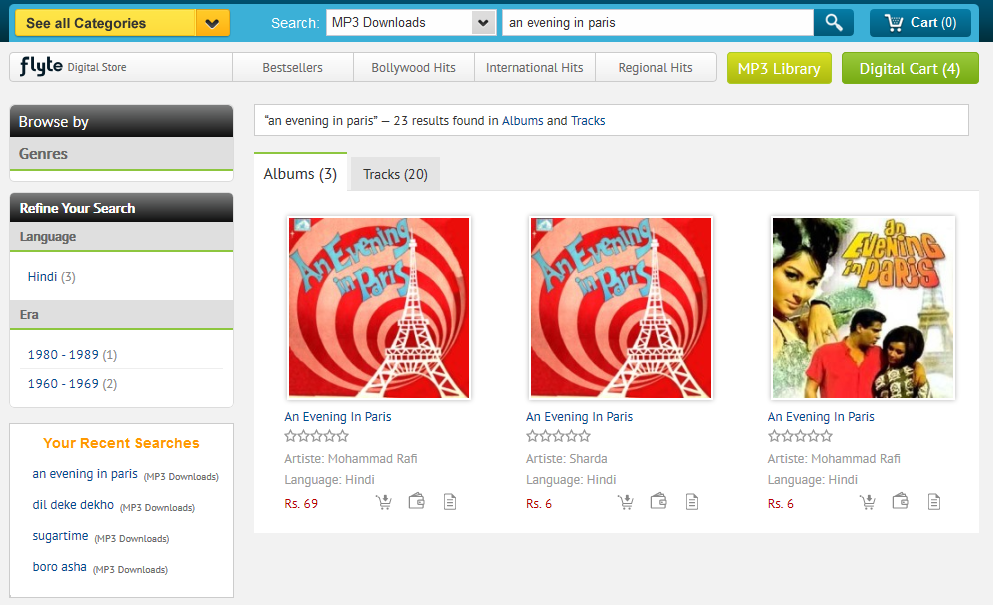
    Album fragmentation: At least for Hindi & Bengali albums. This can lead to a bit of confusion, and also means that you might need to download tracks from multiple albums though they should be clubbed into one.

    image

    New Digital Wishlist: While there’s a separate link to your “Digital cart”, the wishlist link is still the same. However, it’s been split into a Digital & Non Digital section.

    image

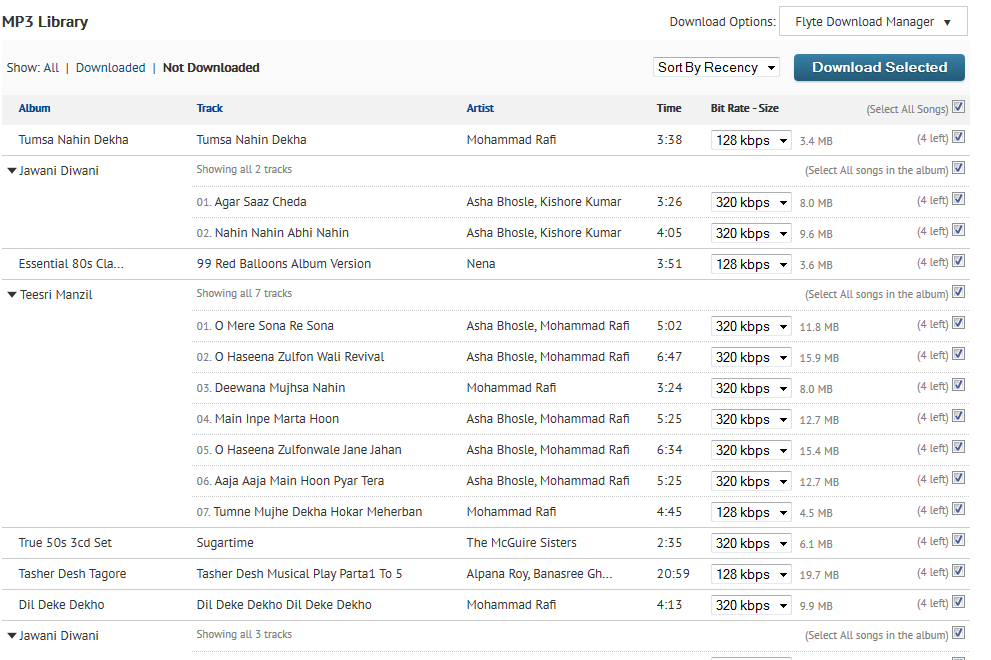
    Downloading files: The MP3 Library gives a convenient list of purchased tracks (wonder when they’ll start a cloud player service). Best of all, there’s a “Not Downloaded” section that makes life easier. You need to download each track separately unless you use the Flyte Download Manager which can download multiple tracks simultaneously. There’s also a counter that shows you the number of times a track has been downloaded – overall limit is 4.

    image

    The download manager is not fool proof though, as you can see below. I was able to fix this issue by letting the successfully added files finish downloading and then grabbing the Not Downloaded files once again from the site. It also seems that the download manager is getting updated frequently and notifies you if there’s an update available.

    One limitation is that you can’t select the download location till the files start downloading. So, only files added after this setting change are downloaded to the new location.

    image

    Price: The prices start at Rs 6 per track, which is for mostly oldies (there are some costing Rs 9 too). Most of the new Indian tracks and the International ones cost Rs 15. The highest I’ve seen so far is Rs 45 for some of the longer International tracks (Star Wars tracks for ex.). Entire albums, as expected, turn out to be cheaper than purchasing every track separately. Most tracks are also available in 3 different bitrates – 320, 128 & 64 kbps (not all oldies have 320 kbps versions though) which gives you flexibility in the bandwidth, storage and quality department.

    What’s missing: The catalogue is pretty comprehensive, especially from the Indian music standpoint considering that even small labels are available. The International scene also seems pretty good, but there are some notable omissions for the time being – Disney and The Beatles. Then again, even Apple took time to get The Beatles onto iTunes.

  • Ra.One

    Managed to watch Ra.One this evening on the IMAX screen (the picture was quite grainy at times, so not sure if it was actually meant for IMAX), and it was definitely a unique experience for a Bollywood movie in terms of the special effects. There are plot holes aplenty in the movie, but if you go in without bias then it can be pretty entertaining (if you managed to sit through TMK, then this one’s a breeze). There are however quite a few other interesting things, including my customary tech observations about the movie:

    • This movie probably has the maximum density of Apple products, given the number of iMacs we are shown, along with the customary iPhone (3 GS though)
    • Which brings me to the second point that it is really peculiar that the game is being developed on iMacs…
    • which have not been using NVidia GPUs for some time now (NVidia is a pretty prominent partner for the movie)
    • The PS3 is probably the only product shown in the movie that uses an NVidia GPU, unless you consider the Alienware laptop & MacBook Pro used in the beginning of the movie for the demo.
    • On the topic of gaming consoles, Microsoft definitely missed out a golden opportunity to showcase Kinect’s motion sensing capabilities.
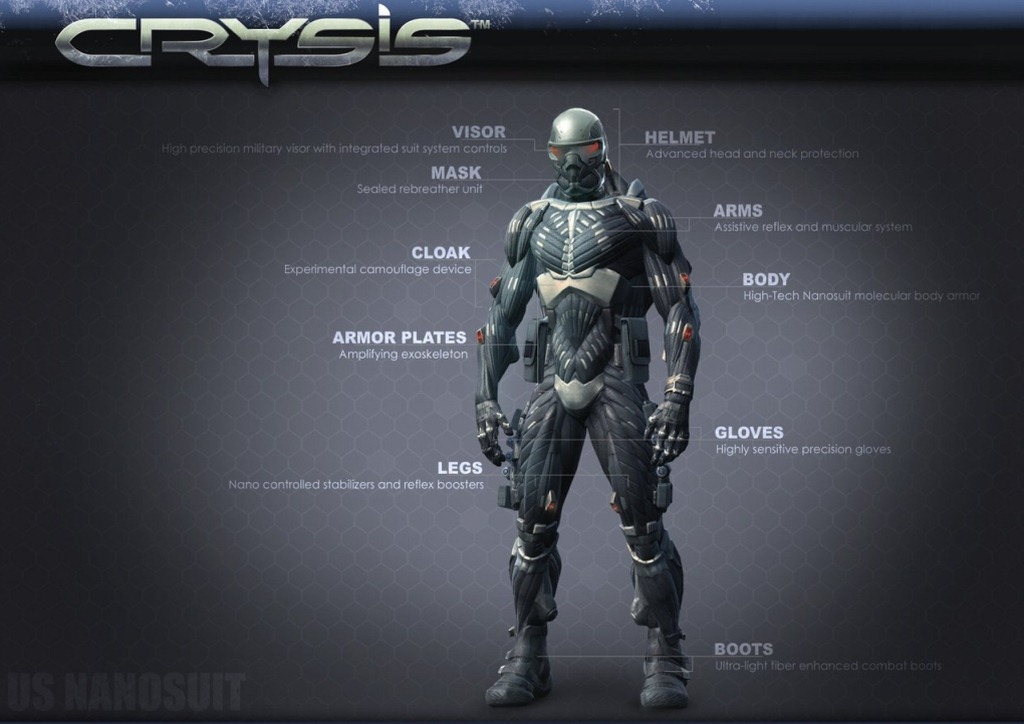
    • The comic book (Superman – he was a jumper initially), video game (Crysis for the suit design, and action games like Mortal Kombat, Tekken etc. for the general concept) and Hollywood (Terminator, Iron Man, Matrix) influences are very apparent.Crysis
    • Talking of video games, Bollywood is definitely getting more serious about them. Even the recent flop Toonpur Ka Super Hero had a climax involving video game concepts.
    • Coming to the non-technical aspects, the movie creators seem to have done quite a bit of Market Research to target the youth segment. The way they have researched action video games is pretty evident. The elite gadgets like the PSP & PS3 are also thrown in for good measure. Besides that, the impact of Japanese animes (just try switching to the Animax channel) is also pretty visible – the first action dream sequence for one. Even the soundtrack is not left alone.
    • The car number plates were pretty interesting, particularly for the VWs owned by SRK – they all had featured IO (Aiyo?) in them. Rajnikanth’s was of course SUPERSTAR.
    • UK seems to be getting back some of Bollywood love that it lost out to the US, with this movie (could have been due to budget constraints though) following in the footsteps of Mere Brother Ki Dulhan and Patiala House.
    • Armaan Verma reminded me a lot of Ritesh Deshmukh
    • SRK also seems to be pretty serious about song copyrights – this time it was “Stand By Me” (after “Pretty Woman” in Kal Ho Na Ho)
    • Last but not the least, Chammak Challo will never be the same once you realise that it is G.One dancing with Ra.One
  • Percy Jackson and the Olympians, the tech discontinuity & more

    Have you found it odd that the first book (The Lightning Thief) in the Percy Jackson and the Olympians series is bereft of cell phone references? I certainly did, and found a likely explanation in the series’ wikipedia page – the book was written in the mid 1990s (Rick Riordan completed the manuscript in 1994), but published only in 2005. Those were the days when cell phones were a lot less commonplace, and kids certainly did not carry them around. In fact, it was probably not that common among adults either. However, the remaining books more than make up for this technology gap (and even offer a post facto explanation for demi-gods not carrying cell phones).

    Coming to the series itself, Percy Jackson and the Olympians was one of the first series that I have read from start to end after the Harry Potter series ended. Incidentally, I also happened to buy all of the books from the Kindle Store and read it across 3-4 devices (on my Samsung Galaxy S & iPod Touch using the Kindle Apps, and my laptop using Amazon’s Cloud Reader – the furthest read location sync is really handy). This was one of the rare times that I also happened to watch the movie before reading the book (unlike Harry Potter, LOTR etc.). I did like the movie when I saw it – quite entertaining with a bunch of special effects.

    However, after reading the book and the entire series, the differences stand out and makes me wonder if they even intend to make movies from the remaining books. And the differences run far deeper than Percy’s pen-sword being a click type vs. a capped one. They’ll really need to rewrite the entire series if they want to bring out sequels, particularly because the main characters are a lot older (already look to be past their 16th birthdays), there’s no Oracle to give out prophecies and the key antagonist – Kronos – is not featured in any way (the latter two could be retrofitted I suppose). I also wonder how Percy is going to take the dip in River Styx when Charon seems to be ferrying people across thin air. The movie however went all out on the tech front with Percy using an iPod Touch as a mirror to defeat Medusa.

    Getting back to the books, there’s another bit that seemed a bit forced and that was the reference to 9/11 and Ground Zero in the later parts (Annabeth’s dream of building a structure on Ground Zero) while it doesn’t come up in the Lightning Thief. This is another piece that gives away the fact that the first part was completed much before the others, and might have even had a reference to the Twin Towers in it which was subsequently edited out.

    All said and done, the series did make me interested in Greek mythology and had me return to playing Titan Quest (Steam had a sale which coincided with my book reading, and I got Titan Quest & its expansion for $5) and long for Age of Mythology. Now, if only there were some Percy Jackson mods for these games…

  • Amazon enters the retail store business with Kindle Fire

    It’s not about tablet wars anymore and the past year has shown that you can’t treat the tablet market like the PC hardware one. From the hardware side Apple is the one who’s going to be profitable for the near future, and the tablet as a PC replacement will really take off once Windows 8 enters the fray.
    Until then Amazon & Apple are going to be the ones making money through tablets. The one who should be really worried is Google, as there Android tablet strategy is falling apart. Looks like Microsoft & Amazon are the ones who’ll be making money from Android. Google really needs to leverage its Motorola deal and go for vertical integration.
    Tablets are more like consumer appliances and that’s the way Amazon is treating the device. So, just like a brick & mortar retailer would rent our buy its shop floor, Amazon is using a tablet to setup its own shop and eliminate the middle man (PCs, browsers etc). Apple is the only one with a similar strategy, albeit across a wider range of devices that are technically more open to competitors (kindle app). Then again their primary revenue is from the hardware sales, while Amazon is all about selling you stuff.
    This will of course change once the tablet market matures & saturates, but that’s a long way away. Apple is the one setting itself up for this future, while Amazon will be there come November.

  • What if Apple released a second iPad this year…

    and it were a 7″ version that had the same 1024×768 resolution as the current 10″ model? For one, they would be able to reach a lower price point, now that the kindle fire is in the scene. Secondly, it would make a good replacement/upgrade for the ipod touch. Thirdly, they do have the content offering along the lines of amazon.
    Of course they lose the economies of scale associated with an iphone-ipod touch combo. It would also help Samsung say that Apple copied them for a change. But, this would pretty much slow down the kindled fire…

  • 2012: The right time for Windows 8 tablets

    Windows_8_Developer_Preview_Start_Screen

    That is of course if the world doesn’t end. Jokes apart, the reason I think that the second half of 2012 is the right time for Windows 8 tablets is that it’ll guarantee the right mix of hardware will be available around that time. Quad core & higher ARM tablets would be the norm then with pretty powerful graphics (which would be a must if display resolutions hit the 2Kx1K levels with the iPad 3). Intel would also be closer to providing a compelling x86 based SoC in the tablet space. In fact, the tablet hardware is going to continue to scale up in leaps & bounds over the next 2-3 years before we reach a level of acceptable performance (just look at the roadmaps of the major SoC makers).


    Apart from the hardware angle, the software landscape and usage model on tablets is also evolving. At the moment people are trying to mostly replicate the desktop or smartphone UI paradigms on the tablet. For Windows 8, it all boils down to how well Microsoft is able to adapt their MS Office UI to the tablet. Then again, we could also be looking at tablets being used as a laptop\desktop replacement when docked – Apple seems to be heading that way with their Thunderbolt display (MacBooks for now).

    So, don’t fret over the timelines, and instead be excited over the emerging paradigms over the next couple of years.

    P.S. Extremetech has a nice how-to for building your own Windows 8 tablet (you will need an existing Windows 7 tablet of course)

  • harman/kardon HS 280 – the 2 month usage review

    hs280

    Got this home theatre system a couple of months back after doing quite a bit research on speakers & home theatre systems. Have been pretty satisfied with the system so far. The footprint is quite small, while the sound quality is very good. And, it looks quite good too. It goes nicely with the Samsung 32” LCD TV that I got earlier, while also serving as a network media player.

    Why a 2 speaker system?

    I went for a 2 speaker system mainly due to the smaller footprint as my living room is not that big, and the additional wiring hassle for a 5+ speaker system, which is a big issue when staying in a rented flat. Also, I was mainly focussed on getting a system to play music well rather than watching movies (it does enhance the sound experience compared to the TV speakers for movies, but 5 speaker systems give you the true surround sound experience).

    The alternatives

    One of the alternatives would have been to go for an A/V receiver with a 2 speaker + sub woofer option and expand later on to a 5+ speaker configuration. However, I eventually eliminated that option as that has its own set of issues. The A/V receiver for one, as going for a low to mid range model could make future upgrades difficult, and second, finding a set of speakers compatible with the initial ones would be another exercise in itself when the time came for the upgrades. Moreover, I would also have to buy an additional DVD\Blu-ray player if I wanted to watch disc content. So, I decided to lookout for a 2 speaker HTIB.

    I came across the harman/kardon HS 280 in the JBL showroom in the Palladium Mall in Mumbai, and it was one of the few 2 speaker systems that I found during my research. The other HTIB alternatives in a similar price range were from Bose. There were also a couple of speaker systems minus the DVD player from Bose in that range.

    The research findings

    I looked around quite a few forums for suggestions on speakers & brands, and saw that Bose had a really poor rating in terms of sound quality (check out this essay that features in a lot of Bose bashings). This was one of the surprise findings from my online endeavours. Some of the highly regarded brands were Wharfedale (warm sounding), Polk Audio (bright) and Klipsch (check out this forum thread for the sound descriptions like warm, bright etc.). However, I found very little information on the system I eventually bought.

    That was when I decided to get some hands on (ears on?) research done & visited a bunch of showrooms to listen to the system demos. The HS 280 sounded really great, both for music (I had made a demo playlist on my iPod & they played it using a stereo cable, but still sounded very good) & movies. As for Bose, I was really disappointed with their 2 speaker systems and I seem to understand first hand the reason behind the forum bashings. I listened to both movies & music (my iPod docked at that rather than using a stereo cable) and the systems sounded pretty flat.

    One of the reasons behind the poor Bose impression could be the fact that I had demoed some great 5 speaker systems from Mirage (Nanosat & MX) & Energy (Take Classic & RC-Micro) just before going to the Bose showroom. If you are considering a 5 speaker setup, do check these out. The Mirage dome speakers in particular create a very interesting cloud of sound effect that’s quite an experience for movies, while the Energy speakers are good value for money. Incidentally, this was at the Atria Mall in Worli, Mumbai. I also demoed a Polk audio 2 speaker set at ProFX in that mall, & understood why they are called bright.

    If you plan to do ears on research, make sure to carry a music demo playlist\CD with you. It will really help in comparing the different systems, and if you are used to hearing the playlist tracks on your existing audio devices, then you have a baseline to compare them with. There are some ready made demo discs (the Chesky Records one in particular) available too that can help you analyse different aspects of an audio system.

    The 2 month impression

    So, after almost 2 months with the system here are my thoughts:

    • Audio quality is really good and the Dolby Virtual Speaker modes enhance the sound in most cases (oldies don’t get impacted much). I’ve listened to a variety of music ranging from oldies (Hindi, English & Bengali) and instrumental to the latest soundtracks and the system sounds great all around.
    • The network play support is a really helpful feature. All you need is a router (I’ve got a Belkin wireless one) & a media server (any machine running Windows 7, or a dlna certified device). You can then play pretty much all kinds of media ranging from music & videos to photos on the system. However, since the device is not dlna certified, you can’t push content to it, i.e., you can select tracks from your PC to have them play on the system. The video format support is also somewhat limited though – doesn’t seem to play mp4, but it does support wmv & xvid\DivX. Also, lossless wma is not supported, so no ripping CDs in lossless formats & streaming them.
    • The system also supports USB storage devices including hard disks, so even if you don’t have a home network, you can always attach external drives & play content. Browsing through the file system can get a bit tedious though.
    • The system has made me appreciate the difference in audio quality between audio CDs and mp3s, especially the lower bit rate ones. In fact, I ended up buying a bunch of audio CDs just to have some good quality audio.
    • The remote can serve as a universal one to control a couple of other devices. You need to program it of course, and the instructions are provided in the user manual. The keys need to be programmed one at a time, and so can be pretty time consuming. I tried programming it for my TV & the Tata Sky box, but the utility is not very reliable as the buttons don’t seem to work most of the time. Overall, the remote is not very user friendly with small buttons and a non-intuitive interface.
    • There are quite a few audio input options including a couple of optical & line in links. So, you can connect your TV audio & a bunch of other devices to the system. No video input options though.
    • The sub-woofer is downward firing, and has a few controls & a 11 o’clock volume position is suitable for most music. It can get pretty boomy otherwise.
    • The disc drive is slot loading & the remote has an eject button – quite handy. The system seems to get pretty hot when playing disc content (this could be due to the confined space I have the system in though)
    • The HDMI video out supports 1080p output and up scales video content accordingly. This goes quite well with our full-HD TV.
  • You Pay More in Mechanical Metered Taxis

    I’ve been doing quite a bit of travelling in taxis in Mumbai over the last 4-5 months, and one of the interesting things I noticed that the fares on the taxis with mechanical meters usually comes out higher than taxis with digital ones. This is especially true when there is a significant amount of waiting time due to heavy traffic. Here’s my theory on why this is so:

    Faulty waiting time calibration on mechanical meters

    On mechanical meters, we use a reference chart to convert the meter reading to the appropriate fare. All this was fine when the meters came out originally many years back and the meters were calibrated for a particular waiting fare rate. However, after several fare hikes that just raised the rate per km & not the waiting time rates, this calibration has become erroneous.

    An example is in order to explain this. Say, initially 1.00 on the meter meant Rs 10 (per km) and 0.10 on the meter corresponded to 2 min waiting time at the rate of Rs 0.50/min (effectively meaning that for every 0.10 you pay Re 1, i.e., the same as the per km rate). Here, we have a uniform multiplication factor of 10 for both distance and waiting time.

    Now, let’s say that there have a series of revisions and the rate per km has doubled, but the waiting rate is still the same. So, we should have 1.00 on the meter corresponding to Rs 20 (per km) as the distance rate, while 0.10 still signifies a 2 min waiting time at the rate of Rs 0.50/min. Therefore, the multiplication factors are now different for distance (20) and waiting time (still 10).

    However, the fare charts are created only keeping the distance fares in mind, due to which you have the following scenario: For a trip of 2 km with a waiting time of 10 mins, the meter will read 2.50 (2×1.00 + 10×0.50×0.10) for both old and new rates.

    • As per the initial rates, the fare would be Rs 25 (meter: 2.50×10 or rate breakup: 2×10 + 10×0.50)
    • For the new rates, the actual fare should be Rs 45 (2×20 + 10×0.50)
    • However, the new rate chart prepared would have only factored the increase in per km rates and would suggest a uniform multiplication factor of 20 for the meter reading, due to which you would end up paying Rs 50 (2.50×20)

    Long live digital meters?

    In the case of digital meters, they are recalibrated (at least in Mumbai, but not so much in Kolkata due to which the same problem exists) for the new fares without changing the waiting rates. Due to this you end up paying the actual fare (Rs 45 from the example above) when you use a taxi with a digital meter.

    Of course, if the driver forgets to wind his mechanical meter before your trip, you end up avoiding the waiting charges altogether which gives you the lowest possible fare. So, I guess there’s a flip side to the whole mechanical vs. digital meter argument.

  • A cynical engineering take on 3 Idiots (movie)

    It’s not everyday that I board a moving bus to reach the movie theatre. Then again, neither do I get to watch movies like 3 Idiots daily. Ever since I watched the movie on 29th Dec, there’s been something about the movie that’s been bothering me. It’s not that I had any kind of expectation from the movie to feel disappointed although it had been getting rave reviews from many avenues. While the movie seems to have tickled the funny bones of the masses, it seemed to hit upon a raw nerve in me. And this has been manifesting itself in the numerous facebook status messages [1] I’ve left on the movie since watching it.

    I read a few reviews and articles [2] on the movie that seemed to be consistent with my feelings of the movie being overhyped. But they too seemed to miss some points. So, here I have an entire post lined up taking on the movie.

    When you have to mock, mock. Don’t preach.

    A funny movie is fine and 3 Idiots definitely scored in that respect. However, it did cross the limit in my books on some respects, particularly on the poverty front (Raju’s family) and treatment of the elderly (Raju’s father and yes, even Virus). All this is fine if you are making a mindless comedy like numerous ones before. But, when you tread into the message giving territory, it just doesn’t go down well. A few explicit examples:

    1. The 3 happily trespass upon the director’s property, one of them into his daughter’s bedroom while the other two deface his property. The director sees the face of only one, and is actually truthful about it. Anyway, this act which would’ve landed them in jail is conveniently brushed aside and totally forgotten by making Raju jump out of the window. “Truth alone triumphs” is not the message from episode I suppose.
    2. And on the topic of truth, lying brazenly to your paralyzed best friend and playing with his emotions may not exactly be the best way to cure him. As far as I remember, even Munnabhai did a better job in such cases. Raju once again saves the day here by a prompt jump back to action and showing that he does see through Rancho’s tricks.
    3. As if one trespass was not good enough, Rancho and Farhan break into the director’s office to steal a question paper, all in the name of friendship. Raju once again saves the day morally here by sticking to his new way of life and tossing away the paper (how one can set an engineering paper that will fail only a select student and how actually getting hold of that paper will help anyone {as people who’ve written open book engineering exams will attest} is another mystery best left unanswered). Of course, the director rushes to the hideout of the gang and tosses them out. This is where mother nature, the Delhi electricity supply and the good old vacuum cleaner come to the rescue adding insult to injury to who knows what.

    Oh well, at least they didn’t shoot some Indian minister dead and try to awaken the public. Oh wait….

    To me, Calvin did a much better job at taking on the education system and I’d gladly stick to Calvinisms than Baba Rancho’s verses any day. I also couldn’t resist the urge to put this in:

    Vintery, mintery, cutery, corn,
    Apple seed and apple thorn,
    Wire, briar, limber lock
    Three geese in a flock
    One flew East
    One flew West
    And one flew over the cuckoo’s nest.

    That’s the source of the title of the movie “One flew over the cuckoo’s nest”, which is definitely a no holds barred take on authority and systems. Watch it if you can and don’t expect to feel anything remotely close to the way you felt after watching 3 Idiots (I wonder how you’d relate the 3 geese to the 3 idiots)

    Also, on the topic of following your dreams, here are a couple of gems:

    1. Bill Watterson’s Keynon Commencement speech from 1990 – “SOME THOUGHTS ON THE REAL WORLD BY ONE WHO GLIMPSED IT AND FLED”
    2. Richard Hamming’s talk – “You and your research”

    It’s not like engineering’s going to ruin your life for sure. Why, I have even done a photography course here in IIT Bombay under a professor who did his engineering (again at IITB), but is into visual communication.

    How old are they and what period are we looking at? They still blog in 2020? No new iPhone version in 10 years! I’m confused.

    This was one of the aspects of the movie that really confused me and the engineer in me had a field day putting together the timelines and ages. One thing I’m sure of is that the movie starts off in the future, somewhere around 2020. This follows from the fact that in the flashback people are seen using mobile phones, youtube, wireless internet etc and that would set the flashback in the present period. Ok, granted that this is not a sci-fi movie, but still, Rancho did file those 400 patents…

    As for the characters ages, nothing out of the ordinary, but a couple of characters come of as oldies, notably Suhas and Pia. As per the flashback, Pia’s supposed to be a doctor engaged to Suhas. That would put her in the mid 20’s and Suhas in the mid to late 20’s given his Management degree and foreign work location (he must have worked abroad for a while or inherited a fortune, otherwise I don’t see anyone gifting their fiancee’s watches worth Rs 4 lakhs). So, this means the following:

    1. An 18 year old was romancing a woman in her mid 20’s. In fact by the time Rancho graduated, she’d be nearing 30 at least.
    2. The doctor and the manager, i.e., Pia and Suhas waited till they were over 40 (or at least Suhas was) to tie the knot. Now that’s dedication for you. I think the director missed a trick here, and the love story plot should have been on these 2…

    That was quite a trip

    Yes, I know, it leads up to Leh and not Ladakh. Still, that was quite an impromptu trip – over 1000 km lasting at least 18 hours.

    And no geeky post can be complete without an xkcd reference. Too bad the characters in 3 Idiots didn’t have this kind of an attitude:

    You should start giving out 'E's so I can spell FACADE or DEFACED.

    Notes:

    [1] A list of all the 3 Idiots related facebook status updates in reverse chronological order:

    1. Did Chetan Bhagat do to the 3 Idiots with his blog post what Rancho did to Suhas with the green chutney?
    2. 3 Idiots is a case of bad credit… or is it credit risk gone wrong?
    3. Some 3 Idiots Math: P (5% < Length of 3 Idiots taken from FPS < 70%) = 99.9966%
    4. More 3 Idiots: Always nice to have a simmering reality show to go with a movie… That too for free.
    5. ICE:IIT::Ladakh:USA
    6. 3 Idiots had its heart in the right place no doubt. Too bad I couldn’t trace its brain…
    7. Avatar appealed a lot more to the engineer in me than 3 Idiots
    8. Lessons from 3 Idiots: 1. Directors should have their offices on the ground floor. 2. Engineers are in serious need of a suicide hotline. 3. Doctors should always carry a vacuum cleaner with them. 4. If you are an MBA grad working abroad, then don’t wait till mid to late 30s to get married, or else your bride may run away to Ladakh to ride a scooter. 5. The Airtel network is better around a remote bridge up north than in the IITB campus & at home in Bangalore.
      6. Pencil wood is also flammable in high oxygen environments & so that’s another factor to worry about – http://www.scientificamerican.com/article.cfm?id=fact-or-fiction-nasa-spen

    [2] Excerpts from the reviews and articles on 3 Idiots:

    Rajeev Masand’s review:

    Going home after watching 3 Idiots I felt like I’d just been to my favorite restaurant only to be a tad under-whelmed by their signature dish. It was a satisfying meal, don’t get me wrong, but not the best meal I’d been expecting.

    …

    The film, in the end, is a broad entertainer that plays to the gallery, well-intentioned but sadly muddled.

    Apurv Nagpal’s review:

    I wish life was as simple as Rancho made out. I wish it was as easy to top an engineering college, life’s issues resolved themselves as easily as shown in the film. The second half, which had a surprise identity crisis thrown in, raised some problems which it was implausible that were not discovered / resolved earlier. But the humour / fun keeps you going through it all.

    …

    My father said after watching it that if you’re willing to suspend disbelief, its an enjoyable film. That’s a pretty fair way of putting it, after all, we do the same for Bond films and a lot of action thrillers. Its just that I didn’t expect to be doing it for a rom com set in an engineering college….

    “From Three Idiots to a Nation Of Idiots” by Sagarika Ghose. The last two paragraphs summed things up quite nicely:

    Yet a film whose central message is “the education system sucks”, “we learn nothing at our centres of excellence” and “teachers are unable to teach and only want to ruin students lives,” is a rather dangerous film. Three Idiots disdains the rigour of study, pours scorn on wanting to better oneself through the sadhna of learning and instead seems to suggest that to be happy in life we all need to drop out, sing songs under the night sky and not bother with studying hard because studying hard is a waste of time. As a former IITian has pointed out Rancho, in the film mocks Laplace Transform, the equation written on the blackboard, as an example of rote learning. Yet without Laplace Transform, Hirani’s computer would not boot up! This former IITian says he has never come across a teacher like Prof Virus, and believes that in its fashionable disdain for education, the film is dangerously juvenile.

    Yes, our education system needs urgent reform. Yes, we need to relook at our exam system. Yes, we need to ensure that parents do not pressurize children. But in the pursuit of educational reform, we cannot allow standards of excellence to be lowered. India’s IITs and IIMs must be applauded for the world-class minds they have thrown up, these are institutions that are respected the world over. Lets not start lampooning Indian engineers by showing them as students who deliver babies with vacuum cleaners. Let’s get real about higher education, not engage in an escapist fantasy and convince ourselves that education does not matter. After all, Rancho could be a subversive because he was a genius student. For those who are not geniuses, alas, there are no short cuts.

    Update (6/1): Missed out the webcomic review.

    Update (12/1): Just came across this fantastic contraption that is bound to bring back memories of our dear friend Lobo from the movie. Too bad he didn’t have an iPhone, otherwise even Virus might have been persuaded. Anyway, check out the video of this iPhone controlled wi-fi quadricopter.