Category: Research

  • What “AI-native” actually means for a founder-led firm

    What “AI-native” actually means for a founder-led firm

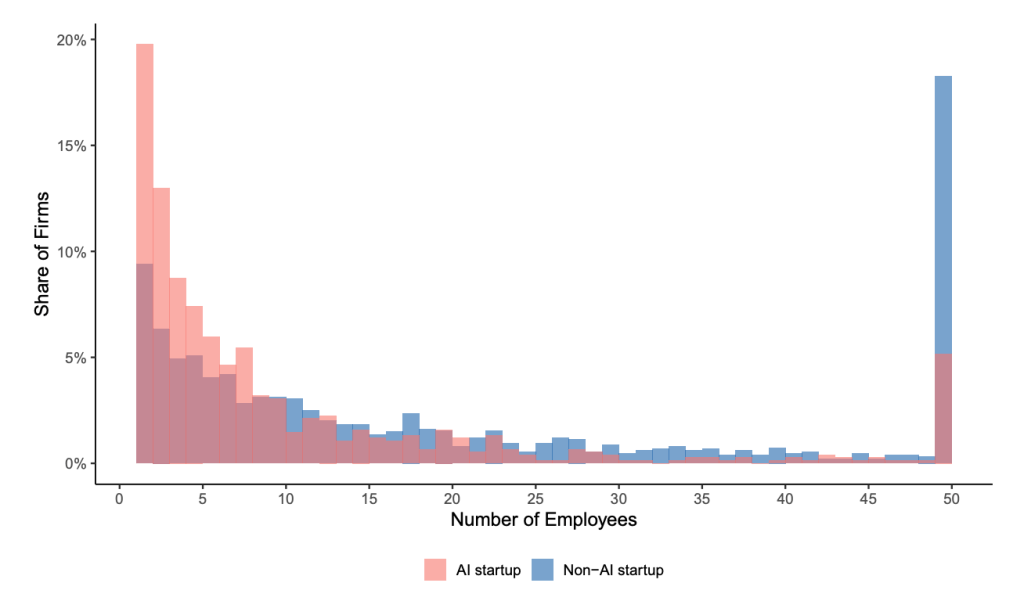
    A recent paper from INSEAD and Harvard looked at close to 3,000 startups and found something that should interest anyone running a small firm. Matched like-for-like, same industry, same age, the ones built around AI ran about a quarter smaller than the ones that weren’t. In services, the gap reached roughly 70%. Fewer people, the same kind of work, and not because they were starving themselves of staff.
    A smaller firm that is worth more

    Across eleven startup batches from 2020 to 2024, the AI-native firms ran leaner and flatter, carried more senior people and fewer managers, and still raised more money and held higher valuations per head than their peers. The smaller size was buying more output per person, not papering over weaker companies. The effect was largest, near 70%, in services firms, the advisory-and-delivery work many of us sell. If your firm sells judgment rather than a shipped product, that number is aimed at you.

    One example makes the shape concrete. An AI slide-deck company reached around $50M of annual revenue in about two years with a team of roughly 30, because making a deck became something the customer does inside the product instead of a job that lands in someone’s queue. A small team, a lot of output, because the work itself moved.

    A fair caveat, which the paper makes and most write-ups drop: a leaner firm need not mean fewer jobs overall. Cheaper output tends to pull in more demand for it (the Jevons paradox: make something cheaper and we usually use far more of it), so the economy can end up with more firms and more total work even as each one shrinks.

    The most telling result is one that didn’t show up the way you might expect. The AI-native firms in the study were about 2.6 times more likely than the rest to name worker-facing tools (ChatGPT, coding assistants, and the like) in their job ads, yet that heavier tool use predicted none of the structural differences: not the smaller size, not the flatter hierarchy. As the authors put it, “equipping workers with ChatGPT, Copilot, or Cursor does not, on its own, predict smaller firms.”

    A large MIT study in 2025 found the mirror image: around 95% of corporate AI pilots delivered no measurable impact, with the failures traced to organisations bolting AI onto existing workflows rather than to the technology itself. Both point the same way. The gains come from redesigning the work, and the licence count barely matters.

    What did track with firm size was where the AI sat. Used inside the firm to speed up work people already do, it moved the structure very little. Built into what the firm sells, so the customer generates the output directly, it tracked with the shrinkage. It is the same move Ben Thompson called an unbundling: the firms that pull ahead fold the act of making something real into the product, rather than keeping it a step their staff perform.

    Governed delegation

    What makes a firm AI-native, then, is how far it has rebuilt its work around what AI can do reliably and what still needs a person watching. Call it governed delegation: you hand the work to AI while keeping your hands on the rules, the boundaries, and the checking. Think of a restaurant that buys a dishwasher but keeps everyone rinsing each plate by hand first. It has added a machine and kept the old routine, so all it has really bought is cost. The gain shows up only when the workflow is rebuilt around what the machine does well.

    Most of this conversation stays inside software teams, which is why the wider point gets missed. The same logic runs straight into sales, marketing, and operations, which is where I have spent the past several months testing it. I run most of OrchestratorAI’s own go-to-market this way: agents handle well-defined pieces of work, and my job is to set the rules and check the output rather than produce each piece by hand. Each group of agents runs in one of two modes, either nothing leaves the building until I have looked at it, or it runs on its own, shows me a sample, and escalates the exceptions. A task earns its way from the first mode to the second only after it stops throwing up things to fix, and some never do. Drafting a note to a high-value prospect stays under review; filling in a basic company profile from public sources does not need me hovering.

    Running it this way taught me something the paper doesn’t quite reach: almost none of the governance had to be invented. We have spent decades building ways to govern people at work: audit trails and compliance checks, standard operating procedures, the maker-and-checker split in finance, code review and the ceremonies of Agile. In a human-only firm a lot of this sits heavy. It adds layers and breeds box-ticking, because people dislike being audited and tire of the checklist, so the control gets watered down to what the organisation or regulators will tolerate.

    Point the same practices at AI agents and the weight largely lifts. An LLM is trained on how people work, so it takes direction roughly the way a person does, and the structure of the playbook carries over. The agent doesn’t resent the audit log or cut the SOP short when it’s busy, so a check that was costly to run on people is cheap to run on an agent. The procedures that were overhead in a human firm become the guardrails of an AI-native one. The autonomous SDLC (the software build-and-ship cycle, increasingly run by agents) is the clearest case I’ve come across: code review, the test gate, the staged rollout that always slowed teams down are exactly what lets an agent ship without a human reading every line.

    The one catch here is that agents fail differently from people. They don’t commit fraud or get bored; they fabricate confidently and come apart on inputs a person would laugh off. So the controls transfer in shape, not in detail: you keep the independent check and the earned trust, but you point them at hallucination and weak grounding rather than at fatigue and dishonesty. Those rough edges are being ironed out quickly. Coding is the clearest case, where agents have grown markedly more reliable over the past year, and making AI broadly more dependable and harder to misuse is a major focus at the frontier labs, still some way from solved. The upshot is that there is already plenty an agent can be trusted to do well today, and the list keeps growing.

    What it means if you run a small firm

    The paper names the real bottleneck, and it isn’t access to AI, which everyone now has at much the same price. It is the mapping problem: working out where, in your particular business, AI actually pays off. That has no generic answer, and finding it is the work that’s left.

    For a founder, the practical shift is that your scarce time moves from production toward direction and judgment, deciding where AI-handled work ends and where human review is non-negotiable. The closer you sit to pure services, the sharper that shift, which is presumably why the services number ran to 70%. Autonomy has to be earned, too: moving a task from supervised to self-running is a track record you build through logging and spot-checks, not a switch you flip. So the key question to put to your own firm is not which AI tools to buy, but which parts of the work can be governed at the boundary, and which still need a person on every output.

    None of this is settled, and the unsettled part is the interesting one: deciding when a piece of work has earned its autonomy, and building the checks so you aren’t flying blind once it runs alone. Strikingly few firms in the data had actually managed it, which makes “AI-native” more aspiration than description for now, even among the companies wearing the label. That is the encouraging part. The tools are here and roughly evenly spread, so the advantage goes to whoever does the slow, unglamorous work of deciding what to hand over and what to keep a hand on.

  • What the 2025 Mary Meeker AI Report Means for Work, Strategy, and GTM

    What the 2025 Mary Meeker AI Report Means for Work, Strategy, and GTM

    It’s been a while since Mary Meeker’s Internet Trends report provided a pulse check on where technology is headed. The first such report in a while, now focused on AI, does more than describe trends — it lays out a new operating reality.

    This post distills 8 critical insights from the report — and what they mean for enterprise leaders, GTM strategists, product owners, and those shaping the future of work.

    📄 Full Report →


    1. This Time, the Machines Move Faster Than We Do

    The report opens with a bold observation:

    “AI usage is ramping faster than any prior computing platform — even faster than the internet.”

    This isn’t just fast. It’s compounding.

    For teams and organizations, that means:

    • Planning cycles must adapt to faster execution rhythms
    • Feedback loops need compression and real-time recalibration
    • Legacy workflows aren’t built for this pace

    If your GTM or delivery cadence still runs on quarterly inertia, it’s time to rethink.


    2. Time-to-Value Just Got Compressed. Again.

    The biggest unlock from GenAI? Time compression.

    From prompt → prototype

    From draft → delivery

    From insight → action

    This collapse in cycle time transforms:

    • Productivity metrics
    • Product development lifecycles
    • Org-wide alignment rhythms

    🚀 Output velocity is the new KPI.


    3. Your Next Teammate Might Not Be Human

    We’re entering the era of embedded AI agents — not just assistants.

    AI is no longer a tool on the side. It’s part of the team:

    • Summarizing meetings
    • Writing first drafts
    • Managing workflows

    That means:

    • Rethinking team design
    • Clarifying AI vs human task ownership
    • Measuring contribution beyond headcount

    AI is a teammate now. Time to onboard accordingly.


    4. It’s Not Risk Slowing AI — It’s Friction

    One of the most important insights in the report:

    Employees aren’t blocked by fear — they’re blocked by poor UX.

    Adoption stalls when AI:

    • Doesn’t fit into existing workflows
    • Requires tool-switching
    • Has unclear value props

    🛠️ The fix? Product thinking:

    • Reduce toggle tax
    • Integrate into natural habits
    • Onboard like a consumer-grade app

    5. AI Fluency Is the New Excel

    The most valuable skill in 2025 isn’t coding — it’s prompt fluency.

    AI Fluency = knowing how to ask, guide, and evaluate AI output:

    • What to prompt
    • What to ignore
    • How to refine

    Every function — from marketing to HR — needs this literacy.

    We’re in the age of human-in-the-loop as a capability, not a compliance checkbox.


    6. Follow the Money. It’s Flowing to AI

    The report outlines the capital story behind the hype:

    • Enterprise GenAI spend is ramping fast
    • Compute infrastructure is scaling explosively
    • VC and corporate funding is prioritizing AI-native bets

    For leaders, this isn’t a trend — it’s a reallocation cycle.

    Infra budgets, product bets, and partnerships must now align with where the ecosystem is heading — not where it’s been.


    7. Go Deep, Not Just Wide

    Horizontal AI gets you buzz.

    Vertical AI gets you impact.

    The report shows real traction in:

    • Healthcare
    • Legal
    • Education
    • Financial services

    Where AI is tuned to real-world roles and workflows, it sticks.

    If you’re shipping AI without domain context, you’re leaving retention on the table.


    8. Infrastructure Is Strategy. Again.

    The biggest shift in the back half of the report?

    AI is putting infrastructure back in the spotlight.

    From model training to agent orchestration to secure runtimes:

    • The AI stack is now a competitive moat
    • Data pipelines and prompt layers are shaping outcomes
    • Infra is no longer invisible — it’s strategic

    What cloud was to the last decade, AI-native infra may be to the next.


    Final Thoughts

    The Mary Meeker 2025 AI Trends report isn’t just a forecast — it’s a framing device. One that challenges every enterprise leader to rethink:

    • How fast we move
    • What value looks like
    • Who (or what) we collaborate with
    • Where advantage is shifting

    It’s not enough to adopt AI.

    We have to redesign around it.

    📄 You can access the full report here

  • From Productivity to Progress: What the New MIT-Stanford AI Study Really Tells Us About the Future of Work

    From Productivity to Progress: What the New MIT-Stanford AI Study Really Tells Us About the Future of Work

    A new study from MIT and Stanford just rewrote the AI-in-the-workplace narrative.

    Published in Fortune this week, the research shows that generative AI tools — specifically chatbots — are not only boosting productivity by up to 14%, but they’re also raising earnings without reducing work hours.

    “Rather than displacing workers, AI adoption led to higher earnings, especially for lower-performing employees.”

    Let that sink in.


    🧠 AI as a Floor-Raiser, Not a Ceiling-Breaker

    The most surprising finding?
    AI’s greatest impact was seen not among the top performers, but among lower-skilled or newer workers.

    In customer service teams, the AI tools essentially became real-time coaches — suggesting responses, guiding tone, and summarizing queries. The result: a productivity uplift and quality improvement that evened out performance levels across the team.

    This is a quiet revolution in workforce design.

    In many traditional orgs, productivity initiatives often widen the gap between high and average performers. But with AI augmentation, we’re seeing the inverse — a democratization of capability.


    💼 What This Means for Enterprise Leaders

    This research confirms a pattern I’ve observed firsthand in consulting:
    The impact of AI is not just technical, it’s organizational.

    To translate AI gains into business value, leaders need to:

    ✅ 1. Shift from Efficiency to Enablement

    Don’t chase cost-cutting alone. Use AI to empower more team members to operate at higher skill levels.

    ✅ 2. Invest in Workflow Design

    Tool adoption isn’t enough. Embed AI into daily rituals — response writing, research, meeting prep — where the marginal gains accumulate.

    ✅ 3. Reframe KPIs

    Move beyond “time saved” metrics. Start tracking value added — better resolutions, improved CSAT, faster ramp-up for new hires.


    🔄 A Playbook for Augmented Teams

    From piloting GPT agents to reimagining onboarding flows, I’ve worked with startups and enterprise teams navigating this shift. The ones who succeed typically follow this arc:

    1. Pilot AI in a high-volume, low-risk function
    2. Co-create use cases with users (not for them)
    3. Build layered systems: AI support + human escalation
    4. Train managers to interpret, not just supervise, AI-led work
    5. Feed learnings back into process improvement loops

    🔚 Not AI vs Jobs. AI Plus Better Jobs.

    The real story here isn’t about productivity stats. It’s about potential unlocked.

    AI is no longer a futuristic experiment. It’s a present-day differentiator — especially for teams willing to rethink how work gets done.

    As leaders, we now face a simple choice:

    Will we augment the talent we have, or continue to chase the talent we can’t find?

    Your answer will shape the next 3 years of your business.


    🔗 Read the original article here:

    Fortune: AI chatbots boost earnings and hours, not job loss


    Want to go deeper? I’m working on a new AI augmentation playbook — DM me or sign up for updates.

    #AI #FutureOfWork #EnterpriseStrategy #GTM #DigitalTransformation #Chatbots #Productivity #ConsultingInsights

  • Human Learning about AI

    Human Learning about AI

    The paper abstract:

    We study how humans form expectations about the performance of artificial intelligence (AI) and consequences for AI adoption. Our main hypothesis is that people project human-relevant task features onto AI. People then over-infer from AI failures on human-easy tasks, and from AI successes on human-difficult tasks. Lab experiments provide strong evidence for projection of human difficulty onto AI, predictably distorting subjects’ expectations. Resulting adoption can be sub-optimal, as failing human-easy tasks need not imply poor overall performance in the case of AI. A field experiment with an AI giving parenting advice shows evidence for projection of human textual similarity. Users strongly infer from answers that are equally uninformative but less humanly-similar to expected answers, significantly reducing trust and engagement. Results suggest AI “anthropomorphism” can backfire by increasing projection and de-aligning human expectations and AI performance.

    raphaelraux – Research

    And a simplified explanation by Copilot (seemed apt to use in this case given the topic):

    The paper explores how people form expectations about AI performance and how this impacts their willingness to use AI. The researchers’ main idea is that people tend to think of AI as if it should perform tasks in the same way humans do. This leads to two key behaviors:

    1. Overestimating AI failures: When AI makes mistakes on tasks that are easy for humans, people think the AI is not very capable overall.
    2. Overestimating AI successes: When AI does well on tasks that are hard for humans, people think the AI is more capable than it actually is.

    Experiments show that these assumptions distort people’s expectations of AI. For example, if an AI struggles with simple tasks, people might avoid using it, even if it’s actually quite effective at other things. On the flip side, if it excels at complex tasks, people might over-trust it.

    The researchers conducted a real-world experiment with an AI that provides parenting advice. They found that users were less trusting of the AI if its answers didn’t resemble what a human would say, even if the information was the same. This shows that making AI seem human-like (anthropomorphism) can sometimes backfire, leading to misaligned expectations between what AI can do and what people expect from it.

    In essence, the study highlights that our human biases can lead us to misunderstand AI capabilities, which can affect how we adopt and use AI technologies.

    From: https://sites.google.com/view/raphaelraux/research?authuser=0

    via https://marginalrevolution.com/marginalrevolution/2024/11/how-badly-do-humans-misjudge-ais.html

    Full paper here – https://www.dropbox.com/scl/fi/pvo3ozkqfrmlwo3ndscdz/HLA_latest.pdf?rlkey=mmz8f71xm0a2t6nvixl7aih23&e=1&dl=0